
Mid-Life Check-up for Congo’s Flagship Dam
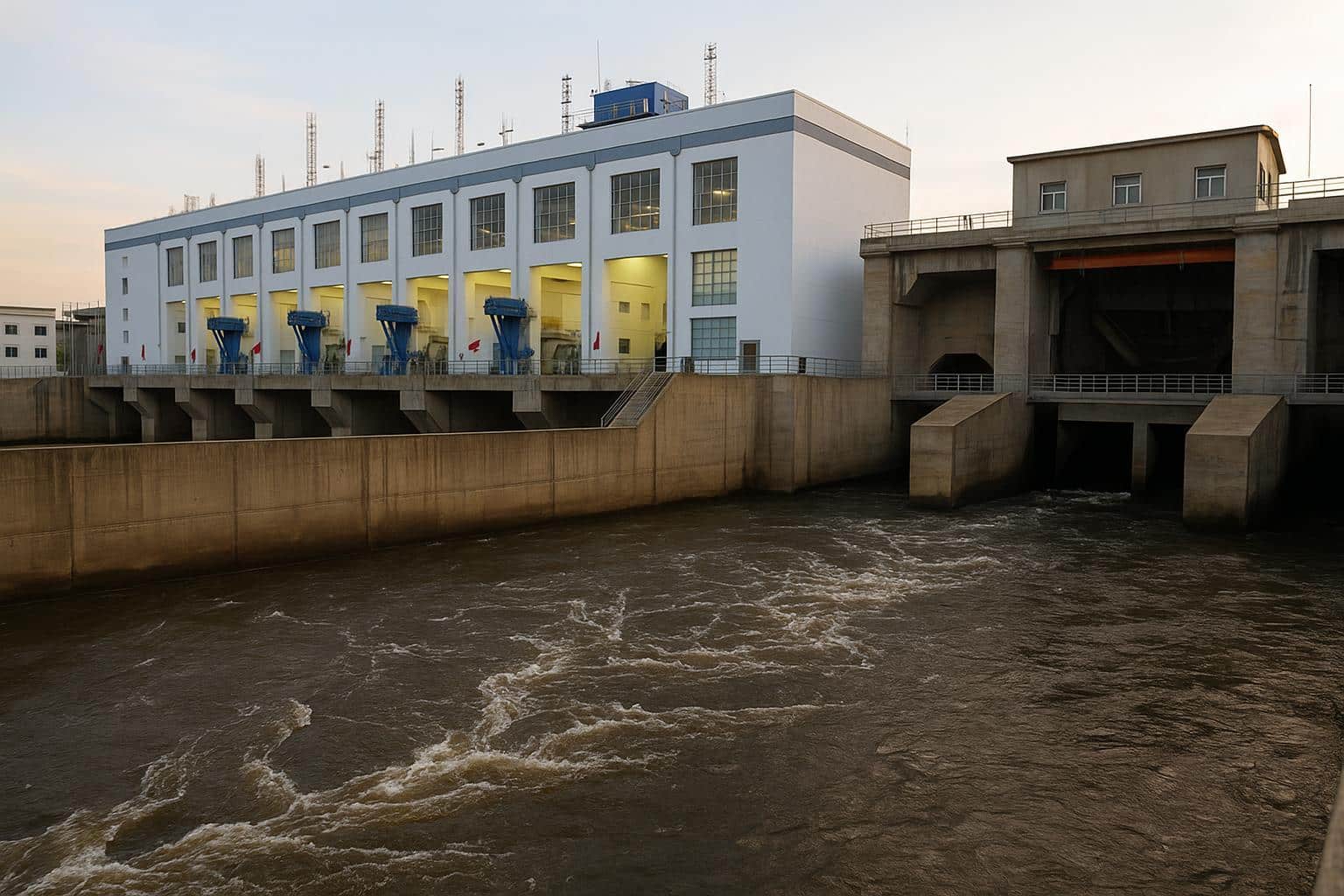
At dawn of Congo’s rainy season, the river Léfini flows calmly beneath the vast concrete arches of the Imboulou hydroelectric dam, a flagship project commissioned in May 2010 to diversify national power supply and stimulate economic growth in Plateaux and beyond.
Fifteen years later, officials acknowledge the facility has entered mid-life maintenance, a normal phase for large hydropower plants worldwide, yet one that requires swift coordination to preserve the asset’s 120-megawatt design capacity and the reliability expected by households from Brazzaville to Pointe-Noire.
On 29 September, Frédéric Manienze, chief of staff to the Minister of Energy and Hydraulics, led a multidisciplinary mission to Imboulou, 170 kilometres north of the capital, to obtain first-hand information on the exact nature of the mechanical and civil-engineering issues reported by operators.
Inside the Turbine Hall: Diagnosing the Faults
Engineers from Énergie Électrique du Congo, the state-owned utility better known as E²C, briefed the delegation inside the turbine hall where the echo of machinery emphasised the gravity of the challenge: only one of four 30-megawatt units is presently spinning at industrial speed.
Unit 2, a 120-tonne assembly including rotor and alternator, lies fully disassembled after a 2024 intervention by partner Fomico. The parts await inspection by Harbin Electric, the original Chinese manufacturer, whose report will identify components to be sourced before the turbine can be rebuilt.
Units 3 and 4 remain idle, pending what technicians describe as standard overhauls delayed by shortages of specialised accessories. As a result, Imboulou currently injects roughly 30 megawatts into the national grid, a quarter of its capacity and a fraction of growing domestic demand.
Civil-works experts from AITPC are meanwhile stabilising sections of concrete eroded by water infiltration after expansion joints between slabs deteriorated. The team is injecting resin and installing new seals, a preventive measure designed to protect electromechanical equipment from humidity and prolong the dam’s lifespan.
Government Response and Repair Roadmap
Speaking beside the spillway, Armel Itoua Ibara Mbimbi, E²C’s production and transmission director, voiced measured confidence: “We have already secured technical scenarios for Units 4 and 3. Once accessories arrive, we will sequence refurbishments to avoid a total shutdown and to maintain supply continuity.”
Ministry officials echo that optimism, noting that the government’s 2022-2026 National Development Plan prioritises energy security as a catalyst for industrialisation. Refurbishing Imboulou is therefore framed not as a crisis but as an investment in resilience, aligned with broader grid extensions under way nationwide.
Nonetheless, the temporary output loss obliges grid managers to balance supply through the Moukoukoulou hydro plant on the Bouenza, gas-fired turbines in Pointe-Noire and imports via the Central African Power Pool, a juggling act that underscores the interconnected nature of Congo’s energy architecture.
Budget, Timeline and Community Impact
Financing the works is under discussion. Sector analysts interviewed in Brazzaville point to a mix of budgetary allocations, concessional loans and potential public-private partnerships, capitalising on Congo’s improving risk profile after recent debt-reprofiling agreements with key creditors. Exact figures, however, remain confidential.
Technicians estimate that a full general overhaul, including replacement of guide bearings, excitation systems and supervisory controls, could take twelve to eighteen months once spare parts reach site. Sequencing the tasks will be crucial to keep at least one turbine available at all times.
Local communities, many of whom benefited from electrification and job creation during the original construction, are watching developments closely. In Etoumbi district, traders report occasional voltage fluctuations, yet several told our reporter they trust authorities to resolve matters, citing previous rapid interventions at Djoué.
Next Steps for a Resilient Energy Future
Environmental specialists add that refurbishments offer an opportunity to upgrade monitoring instruments, ensuring compliance with river flow regulations that safeguard downstream fisheries. Such enhancements would dovetail with Congo’s commitments under the CEMAC Green Energies Initiative adopted in Brazzaville earlier this year.
While timelines are still being fine-tuned, the ministry signals an accelerated procurement process. Manienze confirmed that a detailed technical dossier will be presented to cabinet “in the coming weeks”, after which orders for critical parts could be launched under a fast-track customs regime.
For now, the low hum of the remaining turbine keeps lights on across much of the country, a reminder that hydropower remains central to Congo-Brazzaville’s development model. Ensuring Imboulou’s full revival, stakeholders agree, is less a question of feasibility than of coordinated execution.
