
A pivotal splash for Central African trade
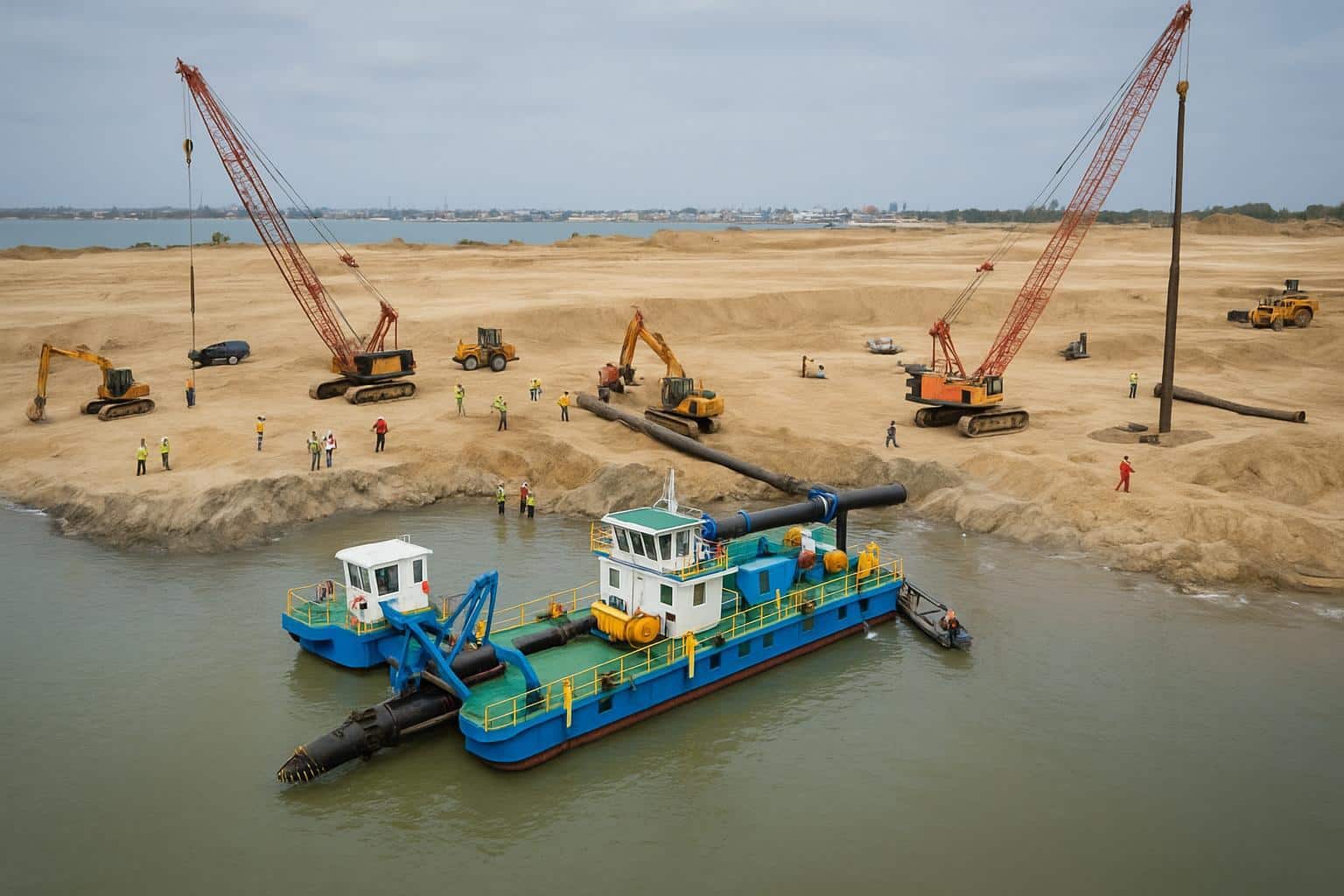
On 20 August 2025, a plume of brown water arced over Pointe-Noire’s harbor as a brand-new cutter suction dredger, chartered by China Road and Bridge Corporation, slid from her barge into position along the Môle Est extension zone, triggering applause from engineers and stevedores.
The maneuver, completed inside the planned safety window, marked the most visible sign yet that Congo Terminal’s 400-million-dollar investment is on schedule, a point underscored by port authorities who insist the platform will double container capacity without disrupting the vital oil and timber export lanes.
Strategic Deep-Water Vision
For President Denis Sassou Nguesso’s government, the Môle Est project supports the national objective of converting maritime geography into diversified growth, complementing hydrocarbon revenue with logistics services that tap rising demand from neighboring Democratic Republic of Congo, Angola and the Central African Republic (Congolese Ministry of Planning).
UNCTAD’s 2024 Review of Maritime Transport flagged Central Africa’s lack of deep-water berths as a competitiveness gap; Pointe-Noire’s natural depth already offers 15 meters, yet the extension will push workable draft to 17 meters, allowing 14,000-TEU vessels to call regularly for the first time.
Engineering Feat: The CSD Launch
The 90-meter cutter dredger, built in Guangzhou and able to process 2,500 cubic meters per hour, will carve a stable trench before layers of basalt armorstone are placed to secure the reclaimed yard. CRBC says the unit’s GPS-assisted head reduces deviation to under ten centimeters.
Aziz Anguilet, project engineer, described the operation as “a choreography longtime in rehearsal,” noting that ocean swell, silt density and tidal amplitude were modeled for six months using software provided by HR Wallingford. “We wanted zero surprises,” he told reporters on the operations pontoon.
Balancing Safety and Sustainability
Environmental compliance remains high on the agenda. The dredger’s exhaust system meets IMO Tier III limits, while extracted sediment is pumped into geotubes for dewatering before reuse in land reclamation, a practice recommended by the World Association for Waterborne Transport Infrastructure guidelines adopted last year.
Independent monitors from Bureau Veritas confirmed turbidity stayed below 15 NTU during the launch, minimizing impact on adjacent mangroves that shelter juvenile fish. Civil society group Eco-Watch Congo acknowledged the transparency of real-time data feeds, though it urged continued vigilance as rock placement intensifies.
Regional Trade Implications
When operational in late 2026, the extended quay will add 800 meters of alongside berth and 30 hectares of yard, integrated with Congo-Ocean Railway links westward to Brazzaville. Maersk analysts predict transit times for transshipment cargo into the Gulf of Guinea could drop by 20 percent.
That efficiency holds political significance. According to the Economic Community of Central African States secretariat, land-locked economies lose an estimated 1.8 billion dollars annually to port congestion. Pointe-Noire’s upgraded capacity is expected to cut customs dwell times, enhancing the region’s Continental Free Trade Area readiness.
Voices from the Dock
Dock foreman Joseph Makosso reflected on generational change. “My father handled break-bulk. I will soon guide ship-to-shore cranes. This dredger means my children could work on even larger ships,” he said, gesturing toward the rusty outline of the original 1939 French colonial pier.
Shipping lines echo that optimism. CMA CGM’s regional manager Helen Doucet stated that reliable 17-meter drafts will allow fewer feeder legs and reduced emissions per box. She added that the company is evaluating a green methanol-ready vessel assignment once shore power connections, planned for 2027, are confirmed.
Next Milestones on the Horizon
The dredger will operate round-the-clock for ten weeks. Thereafter, vibro-compaction teams stabilize the fill, and by April 2026 eight super-post-Panamax cranes from Shanghai Zhenhua are scheduled to arrive. Congo Terminal reports civil works are 52 percent complete, slightly ahead of the reference baseline.
Financing remains secure. The project is backed by concessional loans from China Exim Bank and equity from Bolloré Africa Logistics, recently rebranded as Africa Global Logistics, with syndicate oversight by the African Development Bank, which approved a sustainability-linked tranche tied to labor upskilling benchmarks.
Analysts at Standard Bank note the initiative aligns with Congo’s 2022-2026 National Development Plan, which targets a two-point increase in non-oil GDP. They caution, however, that complementary investments in digital customs and hinterland roads must advance concurrently to avoid bottlenecks simply shifting inland.
For now, the ripple that followed the dredger’s plunge serves as a visible metaphor of momentum. Each cut of the rotating head chips away at both seabed clay and long-standing logistical barriers, reminding observers that in maritime trade, progress often begins beneath the surface.
