
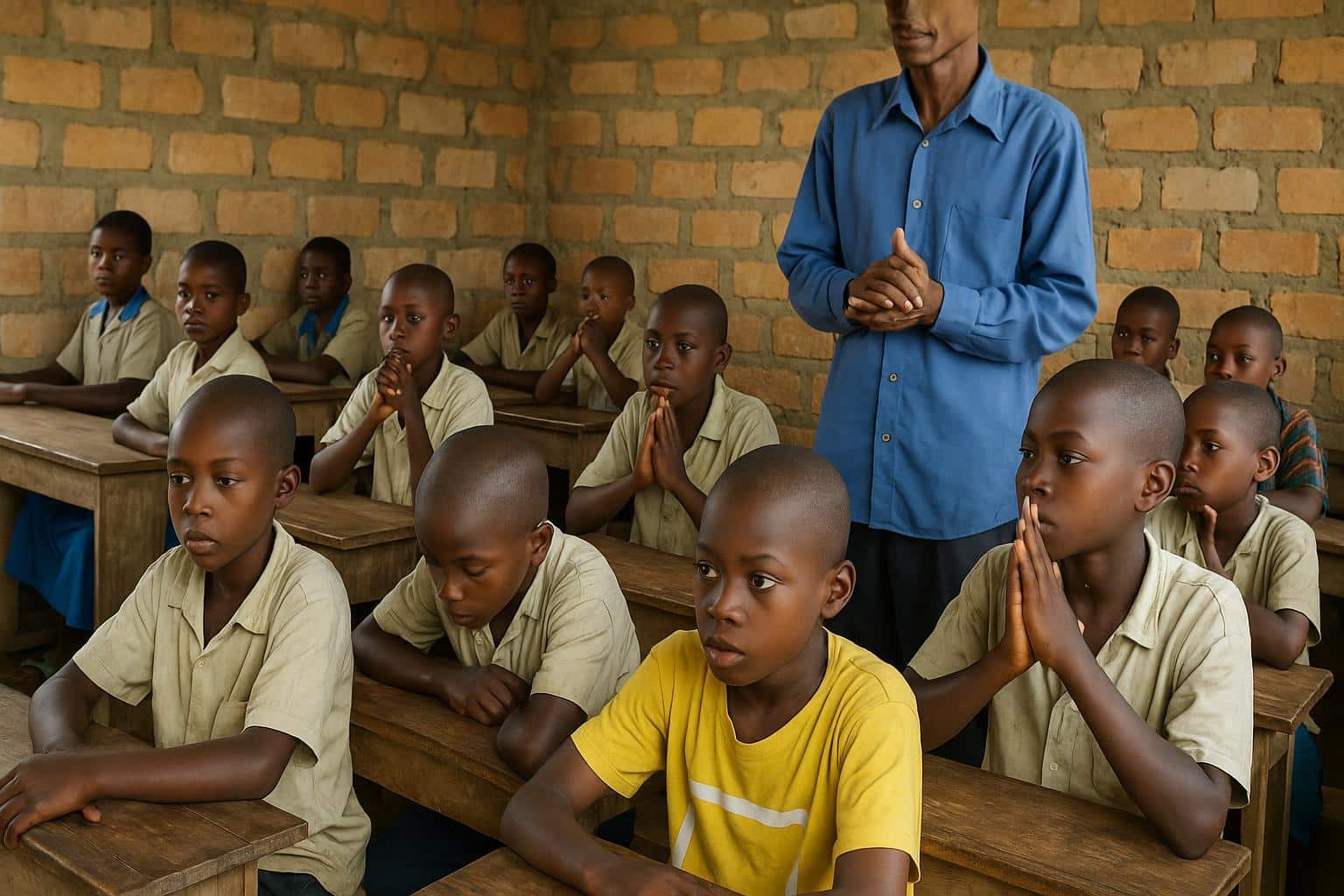
Rural schools start the year with fresh supplies
At dawn, trucks loaded with shrink-wrapped cartons left Brazzaville for Gamboma, Owando and Sibiti, marking the practical launch of a government plan that places 400,000 brand-new textbooks in the hands of rural pupils for the 2025-2026 academic season.
Government doubles down on rural education
Handing the first consignments to departmental prefects, Minister of Preschool, Primary, Secondary Education and Literacy Jean Luc Mouthou underlined that equitable access to learning materials is now a “non-negotiable right for every child, whatever the distance from the capital.”
Textbooks aligned with curriculum and culture
The books cover core subjects—mathematics, French and reading—and were storyboarded by the National Institute for Pedagogic Research and Action to mirror the official curriculum while weaving in local proverbs, farming vocabulary and regional folklore, according to Director General Augustin Mombo.
Teacher coaching accompanies the delivery
Beyond the printed pages, the programme finances refresher workshops where rural teachers dissect the new manuals, practice interactive exercises and learn techniques for multi-grade classrooms. Training sessions began in August at Brazzaville’s École Normale and will travel to each department this semester.
A data-driven follow-up mechanism
Inspectors are tasked with tracking textbook usage through monthly classroom observations, short learner assessments and radio check-ins with head teachers. The feedback loop should identify chapters that spark progress and pages that demand revision before the next reprint.
Bridging a stubborn learning gap
National exam statistics show that rural pass rates in grade-six French trailed city averages by 18 points last year. Officials believe that consistent access to updated materials can close at least half of that margin within three years, especially when paired with trained instructors.
Logistical partners join the effort
The operation relies on the state-owned transport firm SOGETRA for road delivery and the river fleet of the Ministry of Transport for communities along the Congo and the Oubangui. Small aircraft charters will ferry parcels to hard-to-reach districts like Enyellé once runways dry up.
Funding rooted in national budget
Unlike earlier textbook drives funded by multilaterals, this campaign draws primarily on the 2025 national education envelope, reflecting President Denis Sassou Nguesso’s directive that domestic resources secure core social programmes, with external support used only as a complement.
Parents welcome a lighter financial burden
On the market in Makoua, a single mathematics book can swallow a week’s wage for a subsistence farmer. “My daughter used to borrow a neighbour’s copy at night,” said Joséphine Ebina, a mother of four. “This year she will own hers from day one.”
Teachers anticipate richer classroom dialogue
Fifth-grade teacher Arsène Oko told our newsroom that previous lessons leaned heavily on the blackboard. “A book per child means we spend less time copying and more time debating story themes or solving word problems in groups,” he said.
Digital aspirations remain on the horizon
While the ministry is studying low-cost tablets for secondary levels, officials acknowledge that electricity access below 30 percent in many rural hamlets keeps printed manuals indispensable for the foreseeable future, anchoring blended learning plans in practical reality.
Quality assurance through local printing
All copies were printed at the state-backed Imprimerie Nationale in Brazzaville, reducing freight expenses and allowing last-minute curriculum tweaks. The press operates three shifts during peak season, helping sustain 150 skilled jobs, according to its director.
Monitoring early classroom reactions
Initial field visits in Plateaux Department showed pupils poring over colourful illustrations of river life and market scenes. Teachers reported higher engagement during dictation exercises because examples referenced familiar villages instead of distant capitals.
A template for other CEMAC states
Observers from Cameroon’s Ministry of Basic Education attended the Brazzaville launch to study the procurement model, signalling potential replication across the sub-region where similar urban-rural divides curb literacy gains.
Next steps in the learning agenda
Minister Mouthou notes that upcoming phases will extend the textbook catalogue to sciences and civics, then refresh secondary school collections. Parallel strategies will rehabilitate rural libraries and digitise teacher guides for mobile download.
Stakeholders urge sustained momentum
NGO coordinator Clémentine Ngouabi commended the scale of the rollout but appealed for yearly allocations to keep pace with enrolment growth. “A textbook is both the seed and the soil; we must not let it run dry,” she remarked.
An optimistic opening bell
As morning bells ring across forest clearings and savannah towns, pupils flip the crisp pages of their new manuals, a tangible sign that the Republic of Congo’s promise of shared prosperity begins, quite literally, with words they can finally read at home.
