
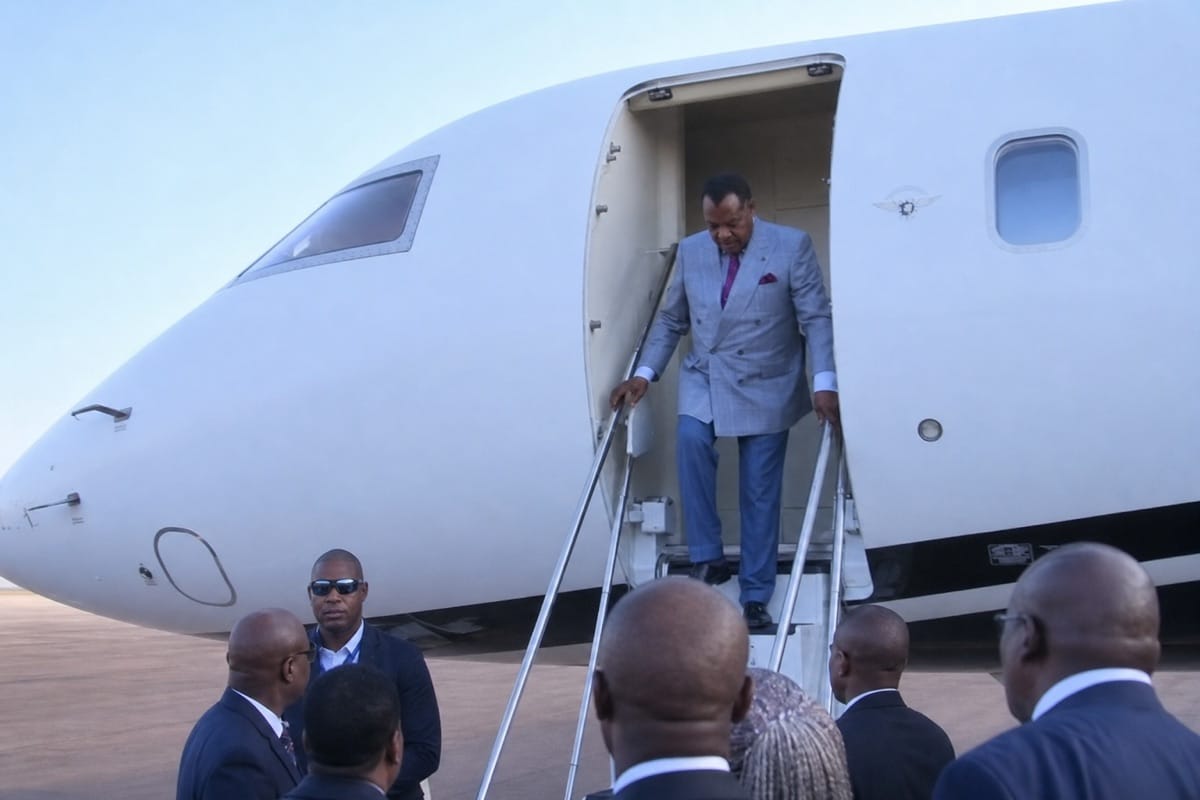
The President Returns from the North
President Denis Sassou-N’Guesso arrived back in Brazzaville on Sunday, May 17, 2026, following a multi-day working stay in Oyo, a city in the Cuvette department in the northern part of the Republic of Congo.
His return to the capital was marked by the customary protocol: a reception by civil and military authorities who gathered to welcome the head of state back to Brazzaville.
Oyo as a Working Space
The town of Oyo, located in the Cuvette department, hosts one of the president’s official residences and has long served as an alternative seat of executive activity. For Sassou-N’Guesso, stays at the Oyo residence are a regular feature of the presidential calendar, used for working sessions removed from the density of the capital’s administrative environment.
During the May visit, the Oyo residence served as the setting for several work sessions focused on state affairs, as well as for meetings with a range of political, administrative, and economic figures. The specifics of those meetings and their participants were not detailed in the available reporting.
Governance Files Under Review
According to reporting by the Journal de Brazza, the president paid particular attention during his Oyo stay to files relating to governance, infrastructure, and institutional stability.
The reference to institutional stability is notable given the political moment: Sassou-N’Guesso’s return from the March 2026 presidential election — which he won — placed his administration in the early phase of a new mandate, a period typically characterized by the consolidation of government priorities and the shaping of policy agendas.
Questions of national infrastructure and economic modernization have been central to the government’s public messaging in this period, and the Oyo consultations appear to have continued that thematic focus outside the capital.
Development at the Center
The reporting notes that Congo’s government has been pursuing several structuring projects across different departments of the country, oriented toward reinforcing economic and social development momentum.
This language, drawn from official framing, points to a broader effort to present national governance not as confined to Brazzaville’s administrative structures but as actively engaged with conditions across the country’s territory — from the Pool department in the south to the northern zones that include Oyo and the broader Cuvette region.
The Routine of Executive Geography
Sassou-N’Guesso’s movements between Brazzaville and Oyo are a well-established feature of political life in the Republic of Congo. The northern residence functions as a place of discreet consultation and decision-making, particularly for sensitive or complex political discussions that benefit from distance from the capital’s media environment.
It is where delegations from various political and economic spheres are known to make their way when seeking direct access to the president. The symbolism of Oyo as a site of power is embedded in the country’s political culture in ways that extend well beyond its administrative function.
Capital Reception
The welcome accorded to the president upon his return followed established protocol. Civil authorities — ministers, senior officials, governors — and military commanders came to receive him, marking the return as an event of institutional significance rather than a purely personal homecoming.
These reception rituals perform a function in the choreography of Congolese political life: they reassert hierarchy, visibility, and continuity. The gathering of officials signals the government’s cohesion around the president and its collective readiness to continue the work of the state.
Context of the Moment
The May 17 return came as the Republic of Congo was preparing for the AfDB Annual Meetings, which opened in Brazzaville on May 25. The period between Sassou-N’Guesso’s return from Oyo and the opening of that major continental event would have placed significant demands on the government’s capacity to coordinate hospitality, security, and diplomatic logistics.
The Oyo retreat, in that context, can be read in part as a space for quiet preparation ahead of an intensive public period — a working pause before the full weight of international engagement descended on the Congolese capital.
