
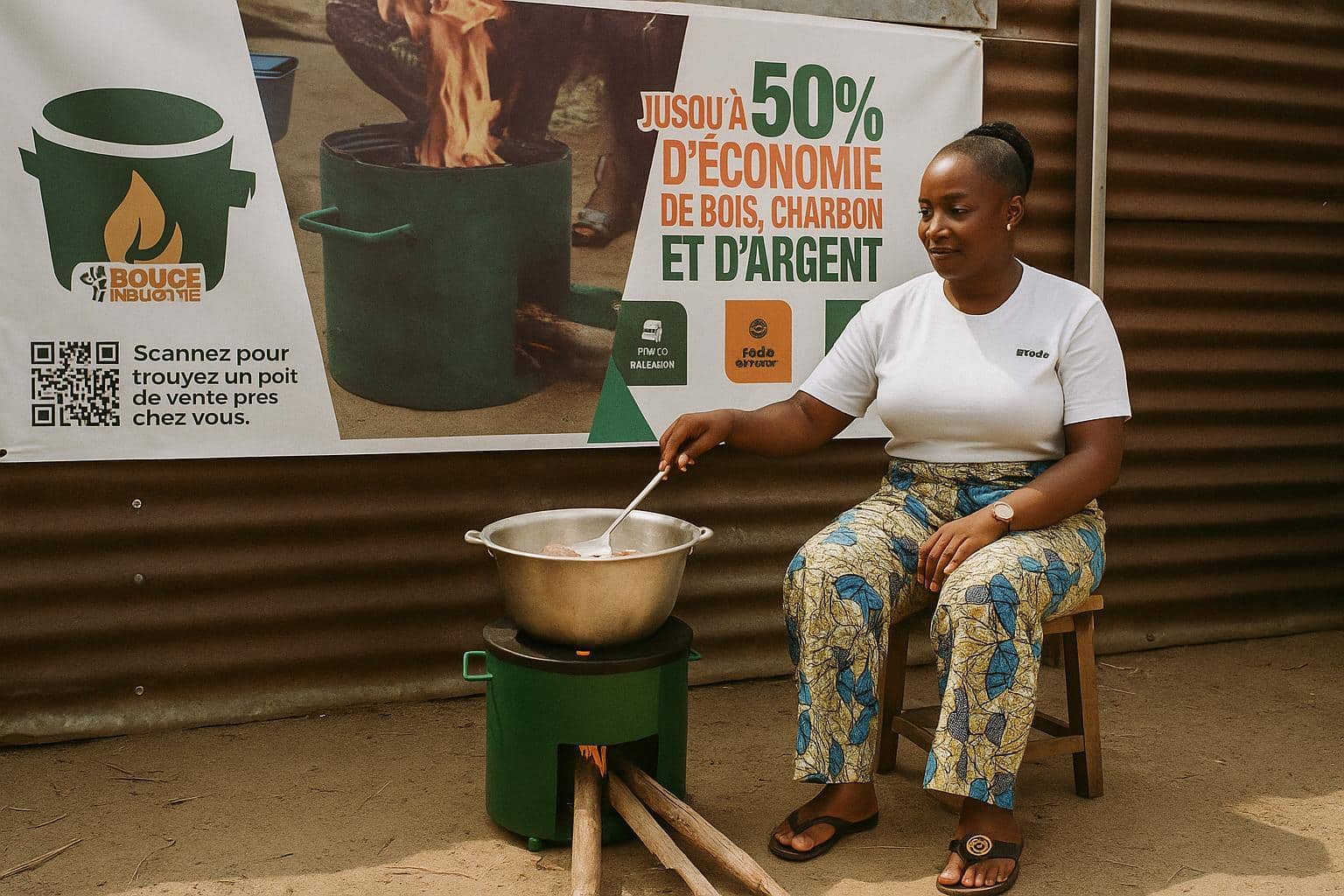
Pointe-Noire demonstration ignites curiosity
Under a canvas awning beside Pointe-Noire’s bustling Mont-Kamba market, nearly thirty women leaned over simmering pots on 7 August. The aroma of cassava leaves and smoked fish blended with curiosity: each pot rested on a silver-grey metal frame called the Congo-Mboté improved stove.
Organised by the French-Congolese NGO Initiative Développement under the Lituka programme, the cooking demonstration aimed to show community leaders that switching stoves can cut household fuel bills without altering beloved recipes. The audience, mainly presidents of neighbourhood savings groups, tasted the evidence spoonful by spoonful.
Biomass dependence shapes daily economics
Figures from the Ministry of Forest Economy indicate that 81 percent of Congolese families rely on wood or charcoal for daily meals, a rate that has remained stubbornly high for a decade (Ministry of Forest Economy, 2023). Most of the gathering nodded: fuel choices are limited and expensive.
Biomass demand contributes to an estimated annual loss of twenty-four thousand hectares of forest cover, according to the Central African Forest Initiative, CAFI (CAFI, 2022). Cleaner stoves therefore sit at the crossroads of environmental ambition, public health planning and the pragmatic budget worries that shape dinner in Brazzaville or Dolisie.
Inside the Congo-Mboté technology
The Congo-Mboté model resembles a traditional brazier yet encloses the flame inside twin metal cylinders insulated with clay. Small side vents accelerate combustion, meaning a handful of charcoal can boil water in nine minutes during tests witnessed by The Congo Chronicle, compared with fifteen on a standard stove.
Flexibility matters in homes that cook both foufou and grilled fish: interchangeable plates allow either wood sticks or charcoal to be used. Local welder Brice Ngoma said the design is ‘straightforward enough for any workshop’, adding that he now sells three units a day, double last year’s pace.
Policy alignment with climate pledges
For policymakers, the stove is a tangible link between Paris Agreement commitments and neighbourhood markets. Lituka, launched in November 2023 by the ministry with financing from CAFI, targets distribution of fifty-five thousand devices in Brazzaville and Pointe-Noire while supporting artisans with training on quality control and small-business accounting.
‘The vision is to couple climate resilience with local manufacturing,’ explained project coordinator Marcellin Nkouka during an interview. He emphasised that every component is sourced domestically, keeping added value inside the Republic and aligning with the government’s new industrialisation plan adopted last December.
Observers from the World Bank note that improved cookstoves have struggled elsewhere when spare parts are imported or marketing ignores cultural habits (World Bank, 2021). Lituka’s managers hope that a women-led diffusion model will sidestep those pitfalls, relying on existing mutual-aid networks that already circulate microcredit and health information.
Early results and health signals
Early feedback is cautiously optimistic. In five months, Initiative Développement has logged sales of 6,400 units and estimates an average household saving of 30 percent on charcoal expenditure. Lydia Bryzelle Babakoula, head of the Rayon du Soleil cooperative, told reporters that ‘with 200 francs you can cook two pots now’.
Health workers at the Tié-Tié district clinic report fewer smoke-related eye irritations among recent adopters, though they caution that systematic data will be compiled only after the next rainy season. Still, the anecdotal link between cleaner air and reduced clinic visits is attracting attention from international respiratory health researchers.
Beyond kitchens, economists see a modest macroeconomic dividend. Lower household fuel bills free disposable income, some of which circulates into school fees and local produce markets, according to a preliminary survey by the National Institute of Statistics. The survey will inform proposals for scaling the programme into northern departments.
Regional stakes and carbon outlook
Donor capitals are watching closely because the initiative aligns with regional forest strategies. Norway’s climate envoy Espen Barth Eide, at COP28, praised the ‘practical focus on women entrepreneurs’, calling the project a possible template for Central Africa’s voluntary cooperation under Article 6 of the Paris Agreement.
Diplomats in Brazzaville note that the project also dovetails with President Denis Sassou Nguesso’s advocacy for a ‘Blue Congo Basin Fund’, underscoring national ownership of climate solutions. By spotlighting locally built technology rather than imported offsets, officials argue, the country reinforces its position as both steward and stakeholder.
Much remains to be measured, from soot reductions to long-term forest regrowth, yet the hiss of a faster-boiling pot is already persuading households. As dusk settled over Mont-Kamba, the women packed their new stoves, promising to return with sales ledgers and, they joked, fewer tears from smoky eyes.
Regional carbon-market analysts forecast that, if adoption targets are met, annual emissions could fall by 310,000 tonnes of CO2 equivalent, a figure validated by the UNFCCC’s Gold Standard methodology. Such volumes are modest globally but would equal removing almost 68,000 passenger cars from Congolese roads each year, experts cautiously note.
Such projections, organisers stress, are only credible if households keep using the stoves after novelty fades.
