
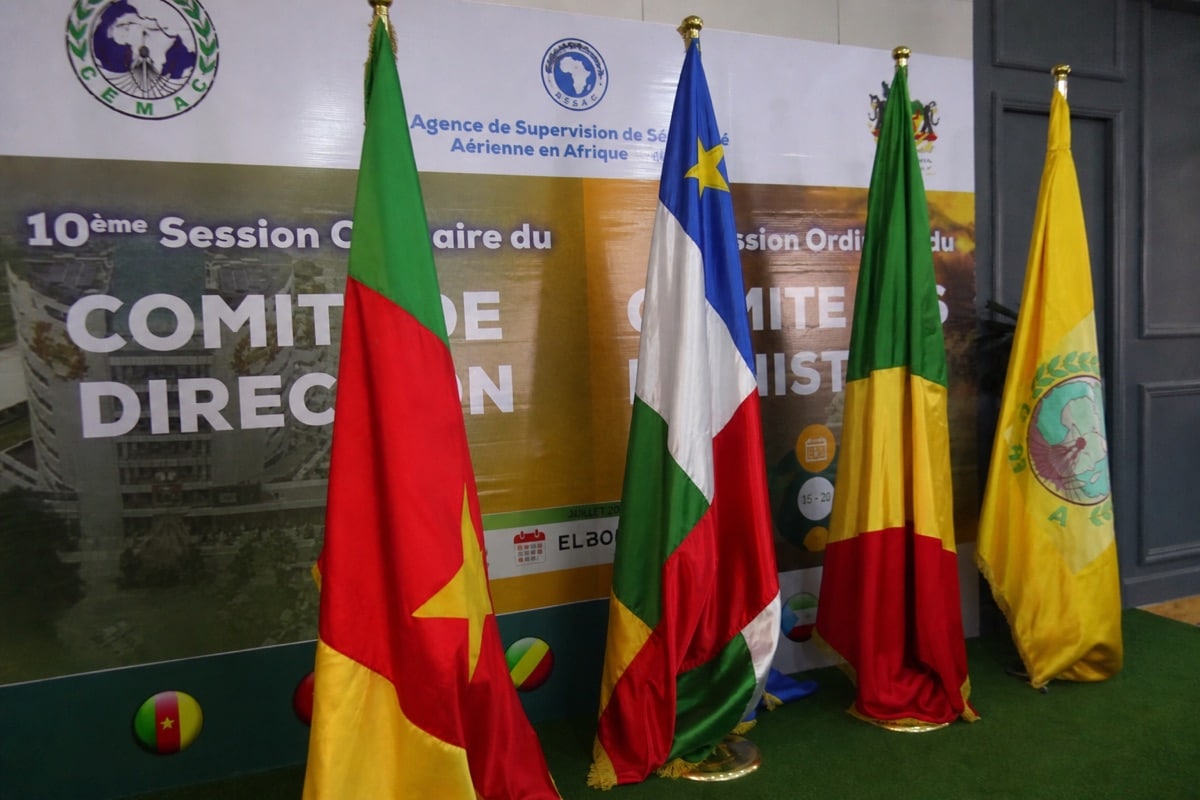
Central Africa moved to tighten its skies this week. Aviation ministers from the CEMAC bloc, gathered in Brazzaville, signed off on a package of seventeen new texts meant to standardize how the region certifies aircraft, trains crews and runs its airports.
A Brazzaville Session With Regional Stakes
The decisions came out of the eighth ordinary session of the Agency for Aviation Safety Supervision in Central Africa, known by its French acronym ASSA-AC. The Congolese capital hosted ministers and technical delegations from across the community for the meeting.
The agenda was less about ceremony than about plumbing. Member states have long flown under a patchwork of national rules, and the session set out to replace that fragmentation with a single, shared rulebook for the sub-region.
What the Seventeen Texts Cover
The reforms cluster around four pillars. The first addresses aircraft airworthiness, the technical condition under which a plane is cleared to fly. The second governs the technical operation of aircraft, the day-to-day discipline of flight operations.
A third pillar concerns personnel licensing, the qualifications required of pilots, controllers and maintenance staff. The fourth covers aerodromes and air navigation services, meaning the runways, towers and systems that guide traffic through the region’s airspace.
Beyond those four areas, ministers also revised the CEMAC Civil Aviation Code and laid down common safety rules. Taken together, the measures aim to give every member state the same baseline rather than competing, country-by-country standards.
Safety Pitched as an Investment Argument
For officials, the exercise is not only regulatory housekeeping. It is also a sales pitch to capital. Eugene Apombi, director general of ASSA-AC, framed the stakes plainly during the session.
“With improved air safety,” he said, the region “will try to fight to attract investors” by making Central Africa a more credible destination. The logic is familiar in aviation circles: insurers, lessors and carriers tend to follow predictable, well-supervised oversight.
That framing matters in a bloc where air links remain thin and expensive. Reliable safety supervision can lower the perceived risk of operating in the market, which in turn can widen the field of airlines and financiers willing to commit aircraft.
Aligning With International Expectations
The broader ambition is convergence. ASSA-AC officials describe the new texts as a step toward bringing Central African practice closer to the international benchmarks that govern global civil aviation, rather than leaving the region as an outlier.
Harmonization also eases a practical headache. When neighboring states apply identical certification rules, an aircraft or a license recognized in one country travels more smoothly across borders, reducing duplication for operators that work across several markets.
For Congo-Brazzaville, hosting the session carries a measure of diplomatic weight. The Republic of the Congo positions itself as an active player in CEMAC’s integration agenda, and aviation safety is one of the more tangible files where shared rules can show quick, visible results.
When the Rules Take Hold
The texts are not yet binding. They are due to enter into force once they are officially published, the procedural step that converts a ministerial decision into enforceable regulation across member states.
That timeline leaves a gap between political agreement and operational reality. Adopting a common code is one thing; embedding it in the daily routines of national authorities, airlines and airport operators will demand follow-through long after the Brazzaville session closes.
A Test of Regional Resolve
The measure of this week’s work will be enforcement, not adoption. A rulebook is only as strong as the inspectors and authorities who apply it, and the seventeen texts will be judged by how consistently they are honored in practice.
Still, the session signals intent. By choosing to legislate jointly rather than separately, CEMAC’s members have bet that pooled standards, not national variation, are the surer path to safer skies and a more attractive aviation market.
If the texts hold up after publication, Central Africa could narrow a long-standing gap between its safety ambitions and its everyday operations. For now, the region has a clearer common framework on paper, and the harder work of making it real ahead.
The Brazzaville meeting thus reads as a beginning rather than a conclusion. The ministers have agreed on the architecture; the coming months will reveal whether the bloc can build the institutions and habits that turn seventeen documents into measurably safer flying.
