
Congo took its case for women traders to a continental stage this week, arguing that Africa’s free-trade ambitions will falter unless the women who already move most of its goods are brought in from the margins.
Brazzaville’s Voice in Abuja
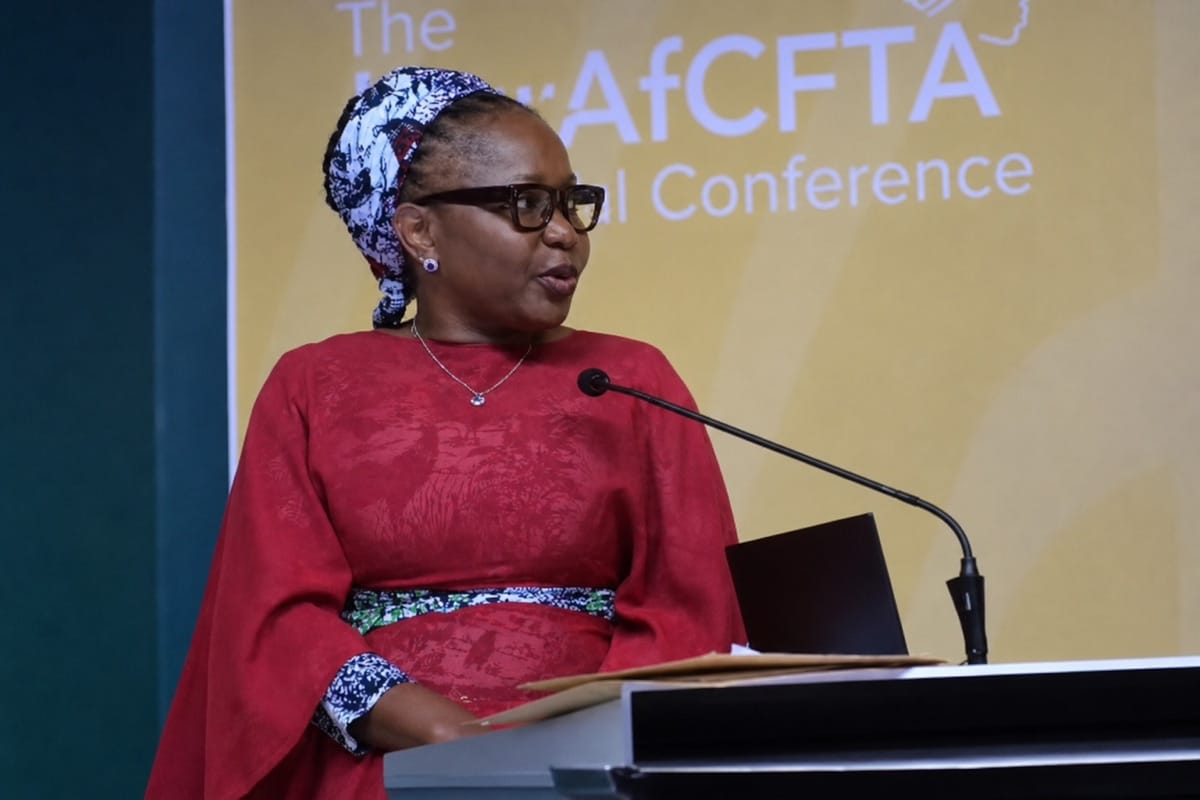
Trade Minister Jacqueline Lydia Mikolo represented the Republic of Congo at the regional HerAfCFTA 2026 conference, held in Abuja, Nigeria, on 29 June 2026. The gathering served as a prelude to the 18th session of the Council of Ministers of the African Continental Free Trade Area.
The choice of venue was deliberate. Abuja, hosting the wider AfCFTA ministerial talks, offered Congo a platform to align its national priorities with the continent’s most ambitious integration project since independence.
The Numbers Behind Informal Trade
Mikolo built her argument on figures that are hard to ignore. Across Africa, women handle close to 70 percent of informal cross-border trade. In Congo itself, the share climbs higher still, with women accounting for more than 80 percent of that same activity.
Those percentages describe a workforce that already sustains regional commerce, often without formal recognition. For Brazzaville, the statistic is less a talking point than a description of how goods actually cross borders in Central Africa every day.
The minister framed these traders not as a vulnerable group needing charity, but as an economic engine operating below the radar of official statistics and policy.
Barriers That Blunt the Potential
Yet potential is not the same as opportunity. Mikolo pointed to persistent obstacles that keep women entrepreneurs from scaling up their activity, chief among them access to financing.
Beyond credit, she cited limited access to markets and to the digital platforms increasingly central to modern commerce. Each barrier, taken alone, is significant. Together, they form a structural ceiling.
The concern reflects a broader reality in the region, where informal traders frequently operate without banking relationships, collateral or the documentation that formal supply chains demand. The gap between what women contribute and what they can claim remains wide.
The AfCFTA as a Conversion Mechanism
For Mikolo, the free-trade area is more than a tariff arrangement. She presented it as a mechanism capable of turning informal traders into competitive African businesses, the kind that generate jobs rather than merely subsistence.
That framing matters for a country like Congo, where diversifying beyond commodity exports remains a long-term challenge. Formalising cross-border trade could, in principle, widen the tax base while opening firms to larger regional markets.
The vision aligns with the AfCFTA’s founding logic, which promises a single market spanning the continent. Whether that promise reaches informal traders, however, depends on the practical rules and financing tools that ministers are still negotiating.
A Continental Endorsement
Congo’s appeal did not stand alone. Wamkele Mene, Secretary-General of the AfCFTA, backed the call to place women more firmly at the centre of the trade agenda.
His support lends institutional weight to a message that might otherwise read as national advocacy. When the secretariat itself echoes the argument, the question shifts from whether women belong in the strategy to how they will be written into it.
For observers in Brazzaville and across the CEMAC zone, that endorsement signals that gender and trade are no longer treated as separate files. They are increasingly read as one.
What Comes Next
The conference produced no binding commitments visible in the immediate record, but it sharpened a framing that Congo intends to carry forward. The task now falls to the ministerial council to translate rhetoric into instruments.
For the women who already carry much of Africa’s trade on their shoulders, the measure of HerAfCFTA 2026 will not be the speeches in Abuja. It will be whether financing, market access and digital tools follow.
