
Local Plans Under the Spotlight
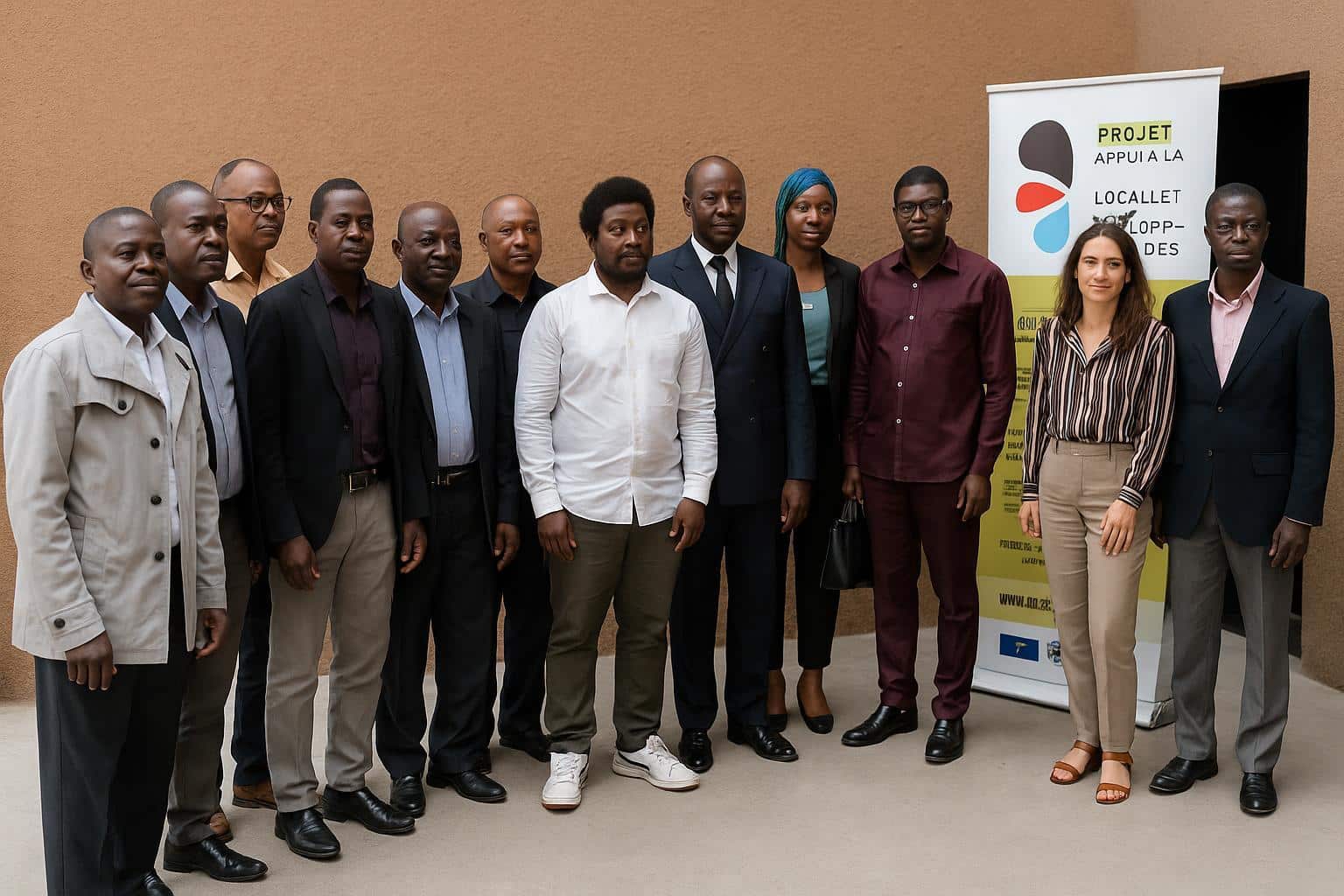
The third-floor conference hall of Brazzaville’s Grand Hôtel echoed with animated debates on 11 July 2025, as municipal councillors, civil-society leaders and technical advisers gathered for an intensive workshop on drafting, executing and auditing Local Development Plans.
The session, led by Guerschom Gobouang, campaign and advocacy manager at the Centre for Action and Development, opened Congo’s two-year project on Local Governance Support and Elected Officials Training, overseen by executive director Trésor Nzila.
It follows a decade of gradual decentralisation in the Republic of Congo, anchored in the 2003 territorial administration reform and reinforced by the 2015 Constitution, both emphasizing the duty of communes and departments to integrate citizen priorities into public investment programmes.
Workshop Highlights Participatory Methods
Financed by the United Nations Democracy Fund, the initiative seeks to enhance how local budgets mirror Sustainable Development Goals, an area observers from the Economic Commission for Africa say is pivotal for unlocking additional concessional financing.
During morning sessions, trainers compared Community Action Plans, compiled through village assemblies, with statutory Local Development Plans approved by councils, stressing the frequent disconnect that can leave water points unrepaired or feeder roads unfinished despite line items in prefectural budgets.
“Our field visits reveal that a top-down matrix designed in Brazzaville rarely captures realities in Impfondo or Dolisie,” Gobouang told the audience, urging elected officials to reverse the logic and allow communities to draft the first page of any planning document.
Thirty participants, including engineers from the Ministry of Planning and activists from Justice et Paix, simulated town-hall hearings in which residents negotiated priorities ranging from cassava-processing units to primary-school roofing, an exercise praised by observers from the French Development Agency as “refreshingly concrete”.
From Top-Down to Bottom-Up Planning
The afternoon module unpacked an 18-step guide for data collection, cost estimation and monitoring, adapted from the World Bank’s Social Fund toolkit and translated into Lingala for ward councillors with limited French proficiency.
Facilitators showcased a pilot from Kindamba district where a base-to-summit approach shortened procurement cycles by two months and trimmed overheads by 14 percent, according to a draft evaluation shared with the class.
Such efficiencies, speakers argued, could help Congo advance Goal 11 on resilient cities, a commitment reaffirmed in March 2025 during the government’s voluntary national review at the UN Economic and Social Council.
National Support and UN Funding
National authorities offered cautious endorsement. “Local councils remain the frontline of service delivery and of the Republic’s credibility,” said an adviser to the Minister of Territorial Administration, noting that draft guidelines emanating from the workshop would be studied for possible inclusion in the 2026 budget circular.
Partners in Brazzaville’s donor community observed the same conversation. The European Union’s governance officer pointed out that alignment with participatory norms could unlock stalled disbursements under the EUR 28 million Programme d’Appui au Voisinage, pending since 2023.
Participants drafted recommendations urging councils to publish quarterly execution reports, mainstream gender budgeting and adopt geographic-information systems for project tracking, echoing best practices highlighted at the 2024 Nairobi Africities Summit.
Regional analysts emphasize that transparent local plans improve climate resilience by guiding irrigation schemes and mangrove protection; a 2023 UNEP brief estimates that every dollar invested at commune level yields four in avoided disaster losses.
Broader Implications for Diplomats
Diplomatic missions based in Brazzaville see another virtue: stronger feedback loops diffuse social tension, thereby supporting President Denis Sassou Nguesso’s effort to maintain a stable investment climate amid fluctuating oil revenues.
Over the coming eighteen months, CAD teams will accompany councils in Niari, Plateaux and Cuvette to test the new templates, with independent auditors slated to release a mid-term scorecard in October 2024.
Researchers from the University of Marien Ngouabi presented preliminary data indicating that communes with active citizen scorecards recorded a seven-point uptick in tax compliance, suggesting participatory planning might also shore up local revenue bases and reduce dependence on central transfers.
A government delegate reminded the room that decentralisation remains a “process, not an event”, drawing applause when he confirmed a forthcoming decree simplifying procurement thresholds for communes under CFA 50 million.
Next Steps and Regional Impact
International experience was also dissected: a video link with Rwanda’s Huye district illustrated how digital dashboards had cut project overruns by half. Delegates queried whether Congo’s mobile-data coverage could support similar dashboards without large capital outlays.
By dusk, a communique drafted in both French and Kituba summarised takeaways and committed signatories to reconvene in January 2026, underscoring the workshop’s ambition to translate discussion into measurable milestones.
Sector specialists foresee that, once refined, the Congo model could inform the African Union’s forthcoming Guidelines on Local Economic Development, scheduled for adoption in mid-2026, positioning Brazzaville as a contributor to continental governance standards.
