
A familiar voice enters the fray
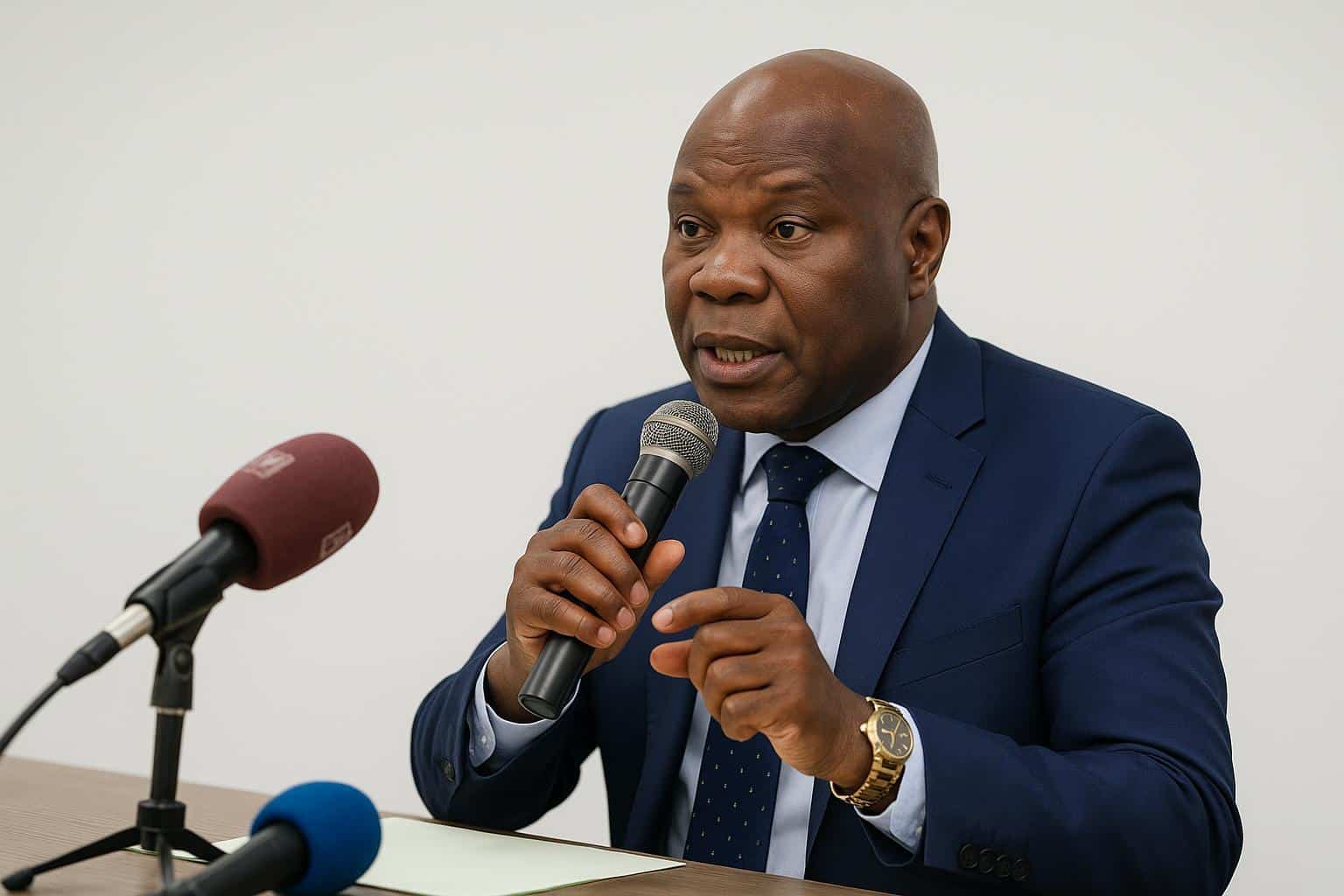
When Alexis Bongo stepped behind the lectern at Brazzaville’s Zola Cultural Center on 16 August, cameras that usually frame him as host of DRTV’s talk show “Homéosthasie” were suddenly aimed from the opposite direction, recording his declaration of intent to contest Congo-Brazzaville’s March 2026 presidential election.
At 56, the outspoken journalist casts himself as a panafricanist and independent, arguing that years of probing social issues on live television have sharpened his understanding of what he calls “the people’s silent priorities” (ACI, 17 Aug 2025). Supporters greeted his speech with rhythmic chants and smartphone flashlights.
The roadmap of ‘Le Congo nouveau’
Bongo’s manifesto, titled “Le Congo nouveau,” sets out five thematic axes: institutional efficiency, diversified economy, modern agriculture, cultural diplomacy, and digital inclusion. The document, still in draft form, was distributed in USB keys to reporters, underlining his attempt to brand himself as a tech-forward reformist.
In his address he promised to establish an “Office of National Innovation” within 100 days to coordinate start-up incubation and e-governance. He cited Rwanda’s Irembo service portal as inspiration, telling journalists, “If Kigali can digitalize civil services in five years, Brazzaville can too” (DRTV archives, 2025).
Youth as strategic cornerstone
Bongo devotes entire sections of his platform to what he calls the “awakened generation.” He proposes a one-year paid civic service for graduates, combining environmental restoration projects with digital literacy workshops, hoping to “weave patriotic discipline with 21st-century skills,” as a campaign flyer obtained by Les Dépêches de Brazzaville states.
Youth organizations offered mixed reactions. The Collective of Congolese Students welcomed the civic service pledge yet questioned budgetary feasibility. Meanwhile, the National Youth Council, an advisory body to the government, said it would “analyze every program with the same diligence we grant all contenders,” in a statement issued 19 August.
Financing an independent bid
To secure a place on the ballot, presidential hopefuls must deposit 25 million CFA francs, roughly 40,500 US dollars under current rates. Bongo told reporters the sum “should not be a democratic barrier,” stressing that crowd-funding platforms and community banquets would cover the requirement without external patrons.
His campaign treasurer, economist Irène Mabiala, later clarified that a transparent ledger would be posted weekly online. Observers from the civil-society watchdog Plateforme 242 welcomed the pledge, recalling that the Constitutional Court rejected two candidacies in 2021 over opaque financing rules (Plateforme 242 communiqué, 20 Aug 2025).
Electoral calendar and legal backdrop
The Ministry of Territorial Administration has yet to issue the official electoral timetable, but senior officials reiterated that the vote will occur “no later than 21 March 2026,” in line with Article 68 of the 2015 Constitution, during a briefing with accredited diplomats on 10 July (ACI, 11 Jul 2025).
Under current law, an incumbent president can seek re-election without term limits. Political scientists interviewed by Université Marien Ngouabi’s Institute of Governance noted that the framework encourages long-term policy continuity, yet also challenges newcomers to articulate distinct agendas that fit within previously announced national development plans.
Measured reactions across the spectrum
The governing Parti Congolais du Travail (PCT) welcomed Bongo’s declaration as evidence of “a vibrant, competitive atmosphere,” according to spokesperson Juste Mabounda. He added that the party “remains focused on implementing the Head of State’s program” and would unveil its own candidate selection timetable after the municipal polls in December.
Opposition leaders were similarly cautious. Pascal Tsaty Mabiala of UPADS said in a phone interview that “every new voice enriches debate,” while urging media professionals turned politicians to maintain journalistic ethics during campaigns. The Centrist Alliance urged candidates to emphasize policy over personality in a communiqué dated 21 August.
Expert insights on media candidates
Professor Diane Nguesso, who studies electoral communication, observes that television anchors command instant name recognition but must rapidly build nationwide grassroots structures. “Broadcast charisma is not the same as door-to-door logistics,” she noted, referencing Cameroon’s 2018 race where journalist Cabral Libii secured only 6.3 percent despite robust online presence.
Bongo’s backers counter that Congo’s media landscape is smaller and that his decade-long interaction with callers on live television provides a quasi-grassroots network. Political analyst Jean-Michel Ondongo argues that such familiarity “can translate into persuasive capital, if supported by a disciplined ground game and coalition outreach beyond urban centers.”
Possible scenarios before March 2026
The National Elections Commission expects the candidate list to solidify by mid-January. If so, observers anticipate a crowded field reflecting the country’s multi-party dynamic established since the 1992 democratic return. Bongo’s team believes early announcement grants them a crucial window to travel across all 15 departments before year’s end.
For now, the journalist-turned-aspirant continues hosting “Homéosthasie” two evenings a week, using on-air discussions to refine talking points while respecting broadcast guidelines that forbid overt campaigning before the official period. Whether this dual role strengthens or dilutes his message will become clearer as the 2026 stopwatch ticks down.
