
Brazzaville Audience Signals Strategic Warmth
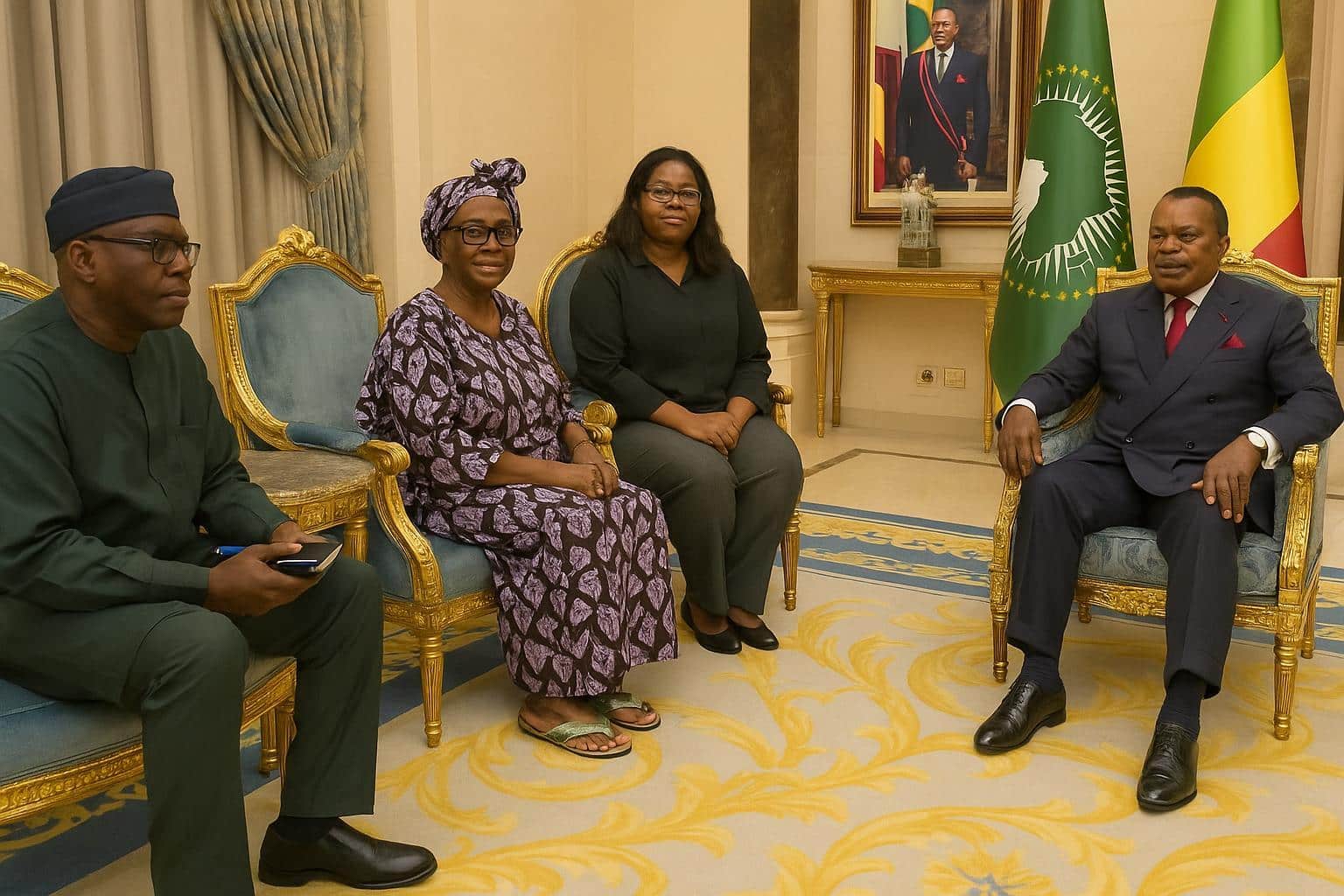
President Denis Sassou Nguesso welcomed Mrs Olusegun Obasanjo in the reception hall of the Palais du Peuple on 5 December, receiving a message from Nigeria’s former head of state that underlined Abuja’s interest in wider ties with Congo-Brazzaville.
The presidential audience came on the sidelines of the 30th instalment of the think tank series known as Fridays at Carrefour, a forum praised for converting dialogue into concrete proposals across business, education, and infrastructure in Africa.
Mrs Obasanjo’s presence added regional weight to discussions that normally draw mainly Central African elites, reflecting a broader trend of South-South partnerships designed to unlock home-grown expertise while consolidating political goodwill among CEMAC, ECOWAS and continental marketplace.
Think Tank Marks Milestone 30th Session
Fridays at Carrefour was founded a decade ago by Congolese technocrats to nurture evidence-based policymaking; its session, held in Brazzaville’s auditorium, confirmed the platform’s staying power despite shifting conditions and two pandemic-affected years that complicated regional travel.
The convenor, Hydrocarbons Minister Bruno Jean-Richard Itoua, opened proceedings by recalling debates on energy transition and employment, before urging participants to chart roadmaps capable of anchoring local value chains inside national budgets and regional development plans.
Observers note that Itoua’s dual role as cabinet member and think tank chair allows ideas generated on Friday mornings to reach ministerial drafting tables the same week, a pipeline many participants see as crucial for accelerating administrative implementation.
Local Content and Domestic Market Debate
The official theme, Local Content and Domestic Market: What to Do, With Whom, Alone or Together? resonated across sectors, especially hydrocarbons, agriculture, and digital services, where repatriating skilled jobs and procurement contracts remains a priority for governments seeking inclusive growth.
Economic analyst Nelly Bitemo told reporters that Congo imports nearly half the intermediate goods used by local industry, a ratio she believes can be lowered through targeted fiscal incentives and cross-border collaboration with manufacturing hubs in Nigeria’s bustling southern corridor region.
Participants also pointed to Congo’s Special Economic Zones in Pointe-Noire and Oyo as laboratories for such integration, citing successes in timber processing and fertilizer blending that responded to the government’s push for value addition before raw materials leave national territory.
For Mrs Obasanjo, the conversation echoed initiatives her husband championed during Nigeria’s 2000s reforms, when Abuja encouraged domestic fabricators to supply the oil sector; she suggested joint training programmes to replicate those results in Central Africa.
First Lady’s Patronage Elevates Agenda
The session enjoyed the patronage of First Lady Antoinette Sassou Nguesso, whose foundation regularly supports educational grants and women’s entrepreneurship fairs; her endorsement signalled top-tier political backing and ensured broader media coverage across public television and private digital outlets throughout the week.
Addressing the auditorium, the First Lady emphasised that strong domestic markets begin with educated citizens and robust family incomes, framing the local-content debate as a social-cohesion issue rather than a purely fiscal negotiation between ministries and multinationals in the country.
Her remarks dovetailed with Congo’s 2022-2026 National Development Plan, which assigns priority to agro-industrial clusters and technical training centres, areas where philanthropic funding can complement budgetary allocations and attract concessional finance from development partners in coming five years.
Regional Diplomacy in the Corridors
Beyond the plenary, Mrs Obasanjo met privately with Foreign Minister Jean-Claude Gakosso and Senate president Pierre Nguimbi, exploring parliamentary exchanges and cultural festivals that could showcase Nigerian literature and Congolese music in each other’s capitals over the next year to foster affinity.
Diplomats familiar with the talks said Brazzaville and Abuja intend to revive a joint commission that last convened in 2017, with working groups on education, hydrocarbon services, and port connectivity, an agenda consistent with the African Continental Free Trade Area.
Analysts view the initiative as a pragmatic complement to Congo’s existing partnerships with China and the European Union, proving that the country can diversify alliances without diminishing long-standing friendships or compromising its principle of non-aligned, open-door cooperation policy.
Next Steps and Measurable Outcomes
In the closing communiqué, participants recommended an annual scorecard to track procurement localisation, mentoring of start-ups by established Nigerian firms, and the creation of a digital knowledge hub where research papers and data sets can be accessed free of charge.
The Ministry of Higher Education indicated it would integrate the hub into existing university networks, while Congo’s telecom regulator pledged spectrum incentives for private operators willing to host local-content servers inside the country, reducing bandwidth costs for students and researchers.
Observers expect Mrs Obasanjo to relay progress to President Muhammadu Buhari’s successor administration, ensuring continuity on the Nigerian side; in Brazzaville, cabinet officials aim to table the proposed scorecard for government approval before the next state budget cycle begins in mid 2024.
As delegates departed, Minister Itoua summed up the mood, stating that the spirit of Fridays at Carrefour is to turn friendly visits into actionable deliverables, a platform that, after thirty sessions, appears increasingly woven into Congo’s national governance fabric.
