
Cultural diplomacy in Muscat
Standing beneath the austere white façade of Oman’s National Museum, Minister of International Cooperation and Promotion of Public-Private Partnerships Denis Christel Sassou Nguesso began a carefully choreographed visit that blended diplomacy, heritage and commerce along the palm-lined boulevard facing Muscat’s royal palace.
His tour on 15 September, situated barely ten kilometres from downtown Muscat and only steps from the Ali Musa Mosque, aimed to deepen Congo-Oman friendship by exploring artefacts that recount the peninsula’s human settlements from prehistory to the contemporary era.
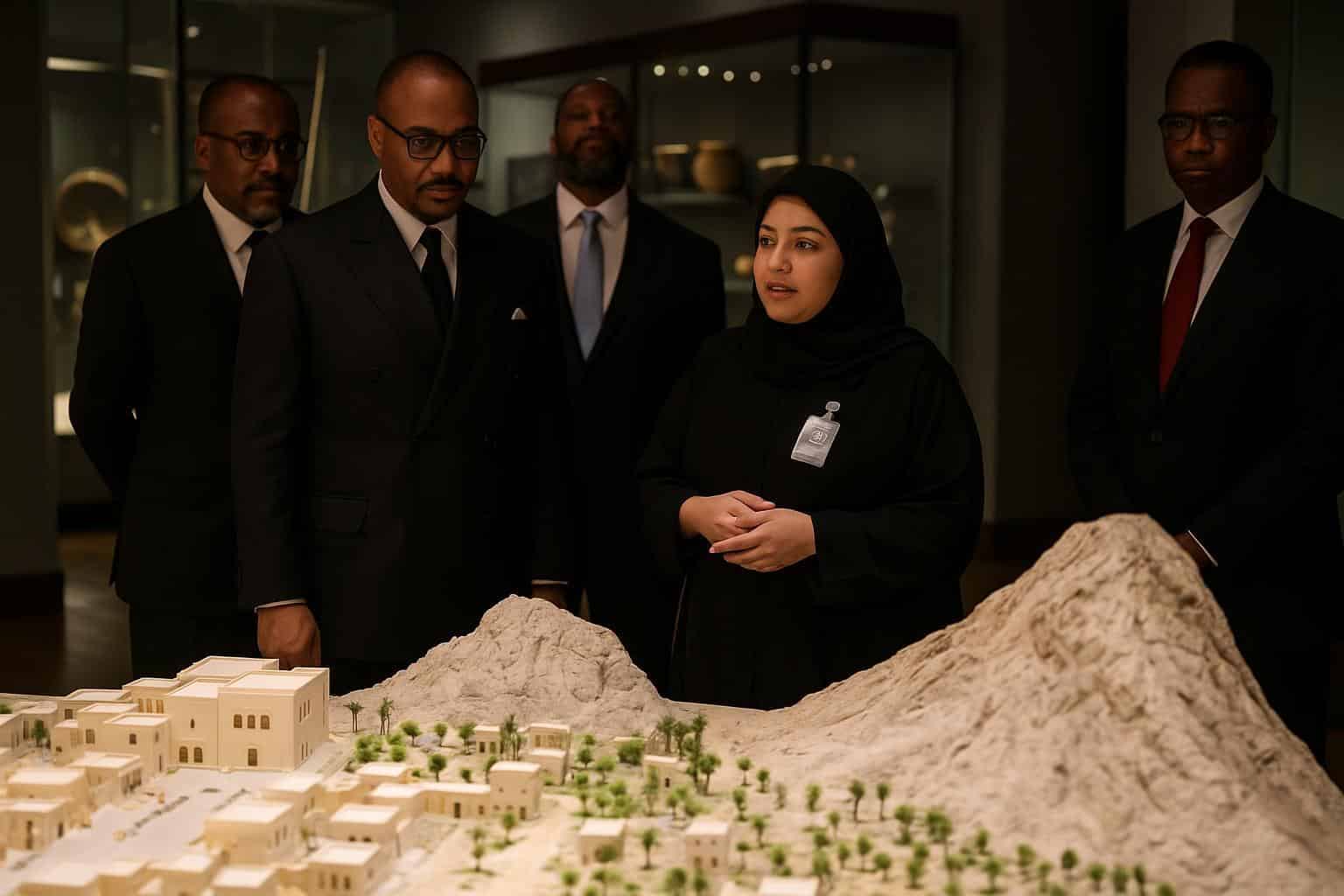
Official photographers captured the minister pausing at a scale model of the Gulf coastline, while curators described how the museum, inaugurated for the public on 30 July 2016, positions itself as the flagship institution charged with protecting and showcasing Oman’s multifaceted patrimony.
A trove of 7,000 Omani artefacts
Across 4,000 square metres and a dozen permanent galleries, the National Museum houses more than 7,000 objects, a density that impressed the Congolese delegation and offered a panoramic narrative organised around themes such as maritime history, arms and armour, and Islam’s arrival.
Curators guided Sassou Nguesso through the gallery ‘Oman and the World’, where gold coins and timber recovered from a wreck believed to be part of explorer Vasco da Gama’s 1503 fleet illustrate centuries-old exchange routes linking the Arabian Sea to distant continents.
In the ‘Prehistory’ wing, stone tools dating thousands of years animated discussions on how geological landscapes have shaped settlement patterns, an observation the minister later connected to Congo’s own archaeological sites along the Batéké Plateau during an informal exchange with accompanying officials.
Heritage as bridge for Congo-Oman relations
Speaking briefly to Congolese journalists, Sassou Nguesso said the visit underscored ‘our determination to place culture at the heart of South-South cooperation’, affirming that collective memory can support economic collaboration ‘just as effectively as trade missions or investment forums’.
Although Oman and the Republic of Congo established diplomatic relations decades ago, cultural exchanges have remained sporadic. Observers within the delegation framed Friday’s museum tour as a signal that Brazzaville intends to broaden cooperation beyond hydrocarbons by highlighting shared narratives of navigation, craftsmanship and religious tolerance.
Director-level staff at the National Museum noted that several West and Central African nations have recently requested expertise on conservation techniques, hinting at potential technical partnerships. Congo’s envoy responded that reciprocal exhibitions could travel to Brazzaville, allowing local audiences to engage directly with Omani artefacts.
PPP lessons from museum management
The minister’s portfolio also covers public-private partnerships, and advisers accompanying him emphasised that museum management provides a model of blended financing that could inspire heritage projects at home. Oman relies on ticket revenue, philanthropic endowments and selective corporate sponsorships to maintain state-of-the-art conservation labs.
Sassou Nguesso referenced forthcoming legislation in Brazzaville designed to attract private capital into cultural infrastructure, suggesting the Muscat model demonstrates ‘how memory can generate jobs, tourism flows and digital innovation without surrendering public oversight’, a remark welcomed by journalists covering the visit.
Within the galleries, the delegation paused before interactive touchscreens that project 3D scans of artefacts. Technicians explained that the digital platform was developed in-house. According to aides, Congo’s Ministry is exploring comparable tools to document traditional Kongo Kingdom regalia stored in regional museums.
Omani specialists also presented a short video on artisan apprenticeship programmes organised under the museum’s outreach wing. According to the presentation, participants learn metal engraving and ship-building techniques. Delegates from Congo observed parallels with initiatives nurturing woodworking in Ouesso and proposed virtual exchanges between trainees.
Prospects for expanded cooperation
Before leaving, Sassou Nguesso signed the museum’s guestbook and exchanged souvenir photo albums with the acting director. Both sides expressed hope the visit would catalyse a memorandum of understanding linking the National Museum of Oman and forthcoming cultural complexes in Brazzaville and Pointe-Noire.
Back in the capital, officials indicate that a joint working group will assess exhibition logistics, customs requirements and educational programming. The minister told reporters that ‘cooperation in heritage management complements existing economic dialogue and demonstrates the versatility of Congo’s international partnership approach’.
Analysts accompanying the mission argued that cultural diplomacy offers a low-risk channel to diversify alliances at a moment when global markets face volatility. They noted the timing of the visit, shortly after the minister’s meetings with investors, underscores Brazzaville’s integrated strategy across sectors.
Throughout the afternoon, museum visitors from several Gulf states stopped to greet the Congolese official, offering impromptu moments of soft-power networking that aides described as ‘invaluable for brand visibility’. Such interactions, they added, seldom feature in formal communiqués yet often yield contacts.
As twilight coloured the Al Alam Palace nearby, the convoy departed, leaving open prospects for future exchanges. Whether exhibitions or scholarly seminars come first, officials agree the minister’s stop at Oman’s National Museum has secured cultural heritage a durable place on the bilateral agenda.
