
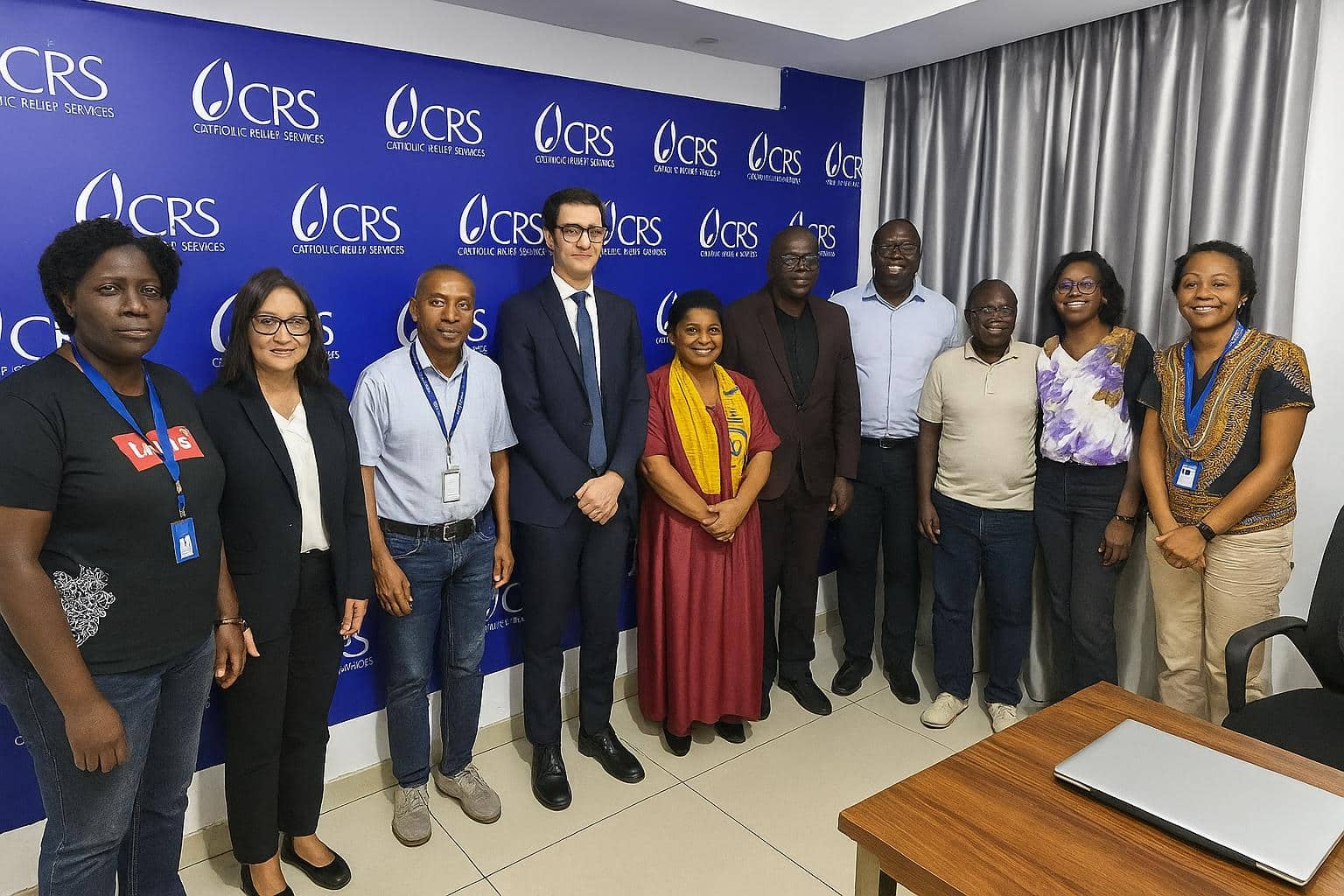
High-level Gavi Mission in Brazzaville
A senior delegation from Gavi, the Vaccine Alliance, walked into the Catholic Relief Services headquarters in downtown Brazzaville on 7 October 2025, closing a pivotal chapter in Congo’s drive to reach every child with routine immunisation.
Led by Country Manager Martin Morand, the visitors reviewed a two-year project that targeted five departments—Brazzaville, Pointe-Noire, Plateaux, Sangha and Likouala—where zero-dose and under-vaccinated children still challenge public health planners.
CRS Resident Representative Dr Alemayehu Gebremariam welcomed the mission alongside programme directors overseeing both Gavi and Global Fund grants, projecting confidence that recent field innovations can be institutionalised within Congo’s Expanded Programme on Immunisation.
The mood in the compact conference room was upbeat, yet deliberately sober, with participants conscious that progress against vaccine-preventable diseases must survive long after donor cycles end.
Routine Immunization Gains 2024-2025
Between January 2024 and November 2025 the project vaccinated roughly 80 percent of the 12 000 children previously untouched by any antigen, a provisional figure officials say already lifts coverage curves in hard-to-reach urban fringes and forest communities.
Mobile teams, supported by community leaders and real-time dashboards, trekked muddy tracks during the heavy rains yet maintained cold-chain integrity, according to field notes shared during the meeting.
Parents interviewed in Brazzaville’s Talangaï district reported shorter waiting times at clinics, attributing the improvement to staggered appointment lists generated by DIGIT+, while several mothers said radio jingles in lingala clarified where and where the teams would be available.
Community health volunteers described the new approach as empowering and time-saving.
Participants also recalled that a measles flare-up earlier in 2025 threatened to derail schedules, forcing rapid integration of outbreak response into regular outreach sessions without eroding focus on infant pentavalent doses.
Health district data verification is ongoing, but provincial supervisors interviewed by this newspaper anticipate that final numbers will mirror the provisional trend once independent monitors complete cross-checks.
DIGIT+ Platform Tracks Zero-Dose Children
A technological highlight of the project is DIGIT+, a geospatial platform that maps households, flags vaccination status and generates predictive routes for nurses.
Screens displayed during the briefing showed colour-coded pins across Ngamaba and Makelekele districts, guiding vaccinators to riverine hamlets that previously required guesswork.
According to the CRS digital health unit, the system reduced average search time per child from two hours to forty minutes while feeding anonymised data into the national health information system.
Gavi delegates signalled interest in replicating the application during Congo’s next Health Development Plan, an indication that donor technology pilots may increasingly align with government digital ecosystems.
Capacity Building Strengthens PEV
Beyond numerical targets, the initiative channelled resources into mentoring district logisticians, retraining data clerks and refurbishing cold rooms, actions the Ministry of Health regards as foundational for resilience.
Trainers emphasised updated micro-planning, applying the WHO Reach Every District approach to Congolese realities, while supervisors refined supportive coaching techniques rather than classic fault-finding audits.
Dr Gebremariam reminded attendees that capacity gains remain national assets regardless of funding cycles, adding, in his words, that ‘skills do not expire with grants; they multiply when embedded into civil-service rhythms’.
Representatives from the Expanded Programme on Immunisation echoed the sentiment, telling this newspaper that refresher workshops will be woven into the 2026 budget proposal currently under inter-ministerial review.
Synergies with Global Fund Cycle 8
Looking ahead, CRS and Gavi examined opportunities to co-manage programme management units alongside the forthcoming Global Fund grants for malaria and health-system strengthening scheduled for 2027–2029.
Officials suggested that shared governance could reduce overheads, harmonise reporting tools and create a single dashboard for commodity tracking, thereby freeing provincial staff to focus on frontline delivery.
No binding commitment was announced, yet both parties described the concept as a ‘smart efficiency’ worth refining before Global Fund concept notes are finalised in 2026.
Observers inside the health ministry argue that integrated stewardship mirrors the government’s broader ambition to streamline partners under a single budgetary framework aligned with the National Development Plan.
Timeline for Closing and Sustaining Gains
A formal closing ceremony, tentatively scheduled for late November, will unveil consolidated figures, lessons learned and a roadmap for sustaining community engagement beyond the life of the grant.
In the interim, district health teams continue uploading final vaccination cards into DIGIT+, while external evaluators contracted by CRS cross-reference tally sheets with household registers.
Gavi’s Morand told reporters that Congo’s experience illustrates ‘how adaptive outreach, technology and local ownership combine to find the last child’ and confirmed that findings will inform alliance policy papers next spring.
For its part, CRS says it will maintain a lean monitoring nucleus until mid-2026 to guide hand-over tasks and troubleshoot any data discrepancies that could undermine national coverage indicators.
As Congo prepares for the next routine immunisation strategy cycle, the synergy displayed in Brazzaville suggests that the momentum built since 2024 is positioned to outlast the grant that sparked it.
