
Elective Congress Faces Legal Clock
On Friday evening, as teams were completing their final training sessions, a new legal petition landed on the desk of the Chamber of Conciliation and Arbitration of Sport, CCAS. The filing seeks immediate suspension of the Congolese Handball Federation’s elective congress scheduled for 10 a.m. on 16 August.
The applicant is lawyer Eric Ibouanga, acting for former candidate Avicenne Nzikou, whose list was disqualified by the Independent Electoral Commission on 14 August. He argues that the commission was formed in breach of a CCAS ruling issued on 13 October 2024, a decision that had demanded wider consultation inside FECOHAND.
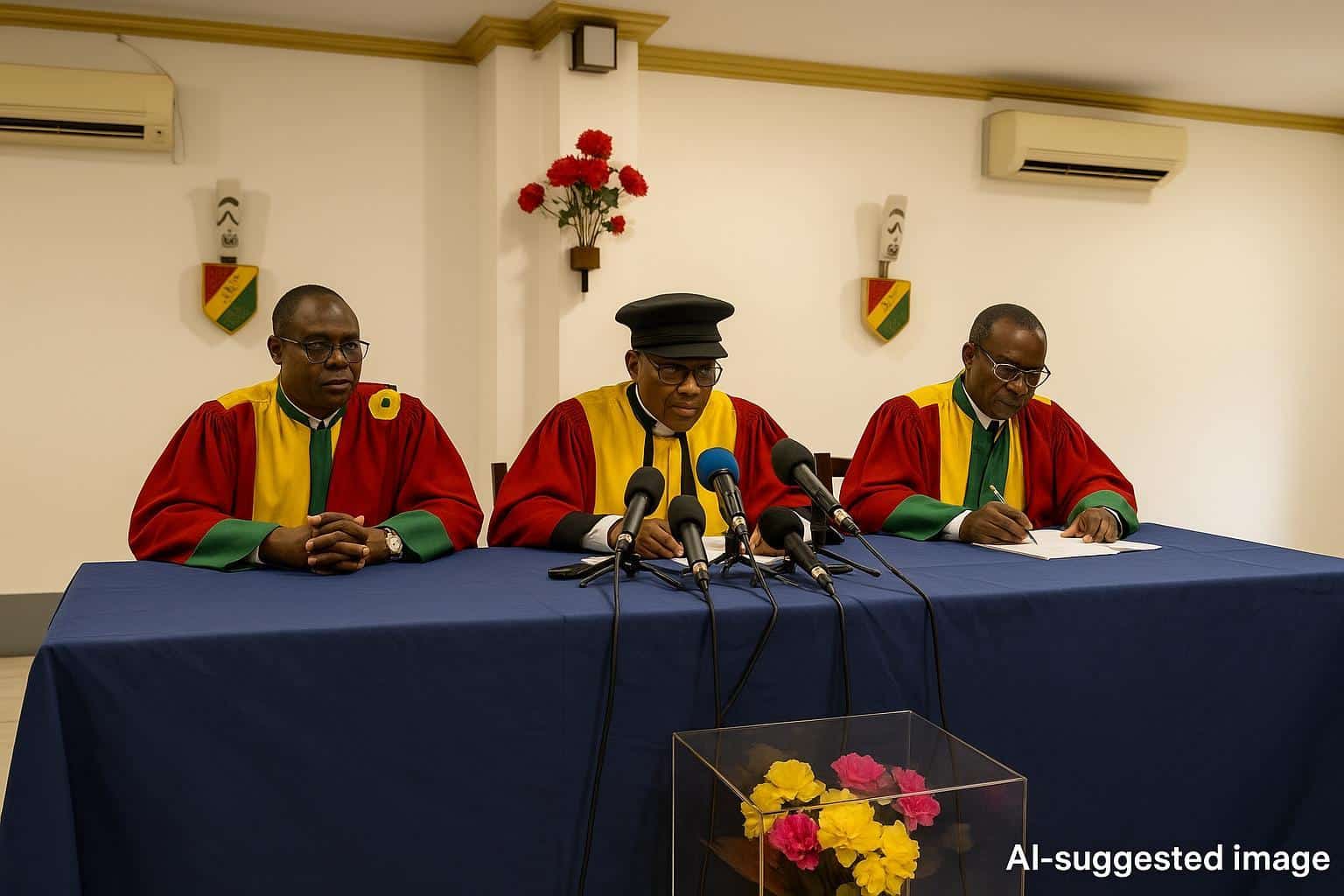
Because the petition arrived under the ‘hour-to-hour’ emergency procedure, the CCAS panel must decide swiftly. Judges have set a dawn hearing, only hours before delegates intend to sign the attendance sheet in a Brazzaville hotel. Whether polling begins on schedule now turns on that hurried session.
Key Actors and Legal Arguments
Counsel Ibouanga describes the request as a protective measure. “The judge may sit anywhere, at any hour, when fundamental sporting rights are at stake,” he told reporters, invoking Article 15 of the national sports charter.
His motion names the National Olympic and Sports Committee of Congo, CNOSC, as respondent. The CNOSC oversees electoral processes for federations and had validated the current roadmap. Yet, according to the applicant, it never executed the 2024 sentence that recommended adjustments to voter rolls and candidate eligibility standards.
Officials inside CNOSC, contacted by telephone, said they had full respect for the tribunal but declined public comment before the hearing. One senior administrator merely observed that federations must function and athletes deserve continuity, a viewpoint echoed by several club presidents interviewed.
Independent Commission Under Scrutiny
The Independent Electoral Commission, CEI, was installed on 30 July after consultations led by interim FECOHAND president Antoine Ngampo. It comprises seven members, including two magistrates and one retired international referee, a structure presented as a guarantee of neutrality.
Dissidents challenge its neutrality, noting that three commissioners previously served on the outgoing executive bureau. They claim this overlap contravenes the spirit, if not the letter, of the 2024 ruling that sought a ‘clean slate’ approach. The CEI counters that its members were elected by the general assembly in a transparent vote.
FECOHAND communication chief Laure Moubani says the body “followed every written guideline from CNOSC and the African Handball Confederation.” She adds that more than two-thirds of the 56 clubs have already accredited their delegates, an indicator, she argues, of broad acceptance of the process.
Possible Scenarios for Handball Governance
Should the CCAS grant provisional suspension, Congo’s handball calendar would enter a grey zone. The federation must send its final list of executives to the International Handball Federation by 30 August to retain voting rights at October’s African congress in Cairo.
One option under discussion would see a caretaker committee, possibly chaired by CNOSC, organise fresh elections within 90 days. Such an arrangement occurred in 2018 for the football federation and kept state funding streams intact, avoiding administrative gaps (local sports archives).
If the petition is rejected, voting will proceed Saturday as planned. Three tickets remain in the race, led respectively by former national goalkeeper Jean-Marc Okemba, veteran administrator Clarisse Ntsonde, and military club coach Dieudonné Koumba. Each has pledged to prioritise youth leagues and greater sponsorship engagement.
Regional Context and Stakeholder Reactions
The timing matters beyond national borders. Congo is bidding to co-host the 2026 Central African Handball Cup with Cameroon, an event expected to draw regional attention and investment. Sponsors have quietly voiced concern that leadership uncertainty could complicate bid documentation.
Sports minister Hugues Ngouelondelé, speaking at a separate event, expressed confidence that “institutional mechanisms will provide clarity.” His brief remark was interpreted by observers as reassurance that the state will not intervene directly, reflecting a hands-off approach consistent with international sports governance norms.
Players, meanwhile, try to stay focused on the upcoming domestic season. “We train, we wait, we hope,” said Pointe-Noire winger Blanche Malanda, whose club depends on federation grants for travel. Her words capture the athlete’s view: governance debates feel distant, yet their consequences are concrete.
What Next for Congolese Handball
Regardless of the CCAS decision, most analysts expect reforms to the electoral code during the next cycle. A working draft circulated in May suggests longer campaign windows and mandatory public debates, reflecting a continental trend toward transparency championed by the African Union Sports Council.
Diplomats in Brazzaville note that sport has often served as soft-power terrain where Congo projects stability. A well-managed resolution, they argue, would reinforce that narrative ahead of next year’s African Games, when Congolese athletes aim to improve on their 2019 medal tally.
For now, all eyes remain on the dawn courtroom where three judges must balance procedural rigor with the federation’s operational needs. Their ruling, delivered perhaps before sunrise, will decide whether whistles blow at the ballot boxes or if silence descends upon an assembly hall already prepared for a vote.
