
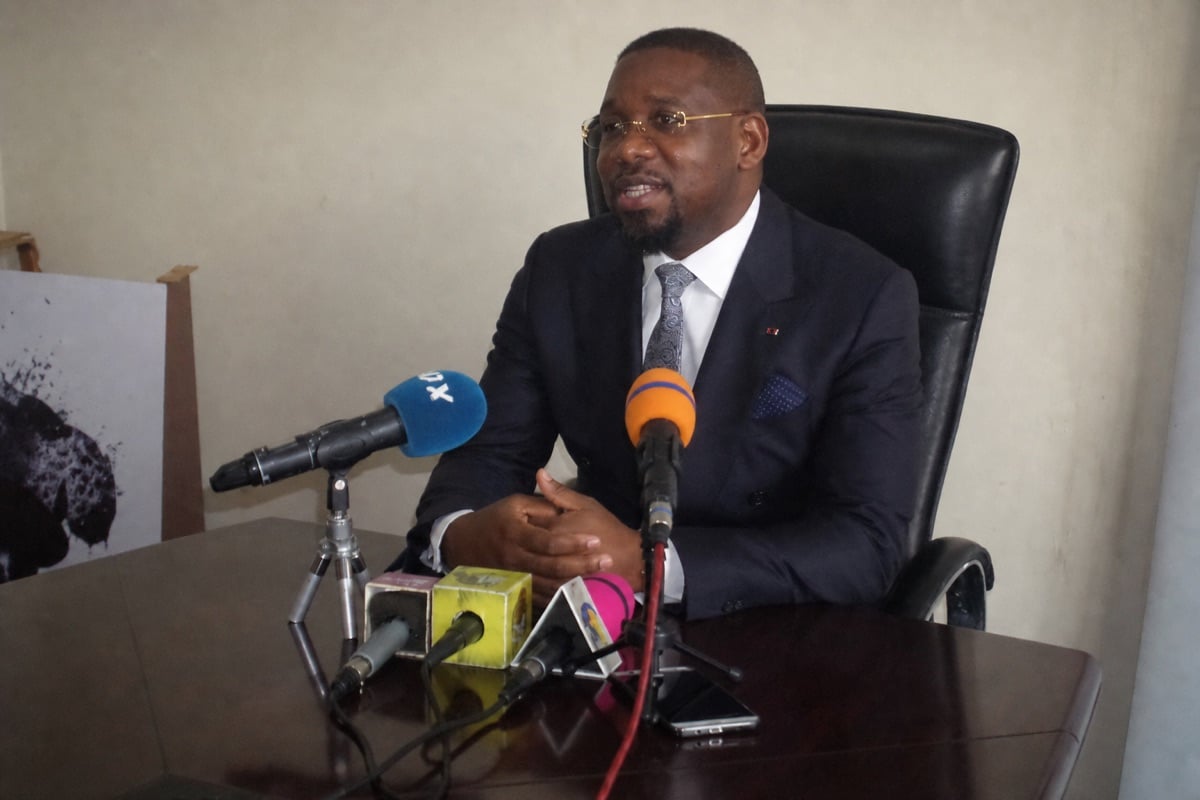
A political fixture in Congo-Brazzaville has stepped aside. Juste Désiré Mondelé, secretary general of the Club 2002-PUR for more than two decades, has resigned, unsettling a party that presents itself as a pillar of support for President Denis Sassou N’Guesso.
His departure lands at a delicate moment. The Parti pour l’unité et la République is preparing its first ordinary congress, a gathering meant to organize its internal life and confirm its direction. Mondelé’s exit clouds that ambition.
A Resignation Delivered By Letter
Mondelé formalized his decision in writing. The letter was addressed to Guy César Wilfrid Nguesso, president of the party’s supervisory council, according to the account of his departure. The choice of a written, formal channel underscored the seriousness of the break.
For a leader who had shaped the secretariat for over twenty years, the move marked a rupture with a party he helped run. Few figures had been as closely identified with the machinery of the Club 2002-PUR as its long-serving secretary general.
The Grievances Behind The Break
At the center of the dispute are decisions taken on June 26 concerning the organization of the first ordinary congress. Mondelé contests those measures, arguing that they did not follow the party’s own internal rules.
He described the problems as irregularities of an administrative, hierarchical and protocol nature, according to the terms attributed to him. His complaint was less about a single act than about a process he judged inconsistent with the party’s established procedures.
The framing matters. By pointing to administrative and protocol failings rather than ideological differences, Mondelé cast his departure as a question of governance and internal discipline, not of loyalty to the movement’s political line.
Positions Left Vacant
The resignation carries weight because of what Mondelé gives up. He relinquishes his role as secretary general, the post that had defined his standing within the party for so long.
He also steps down from his function as vice-president, a senior position in the party’s hierarchy. Alongside it, he surrenders his role as personal representative of the national president on the national preparatory committee.
Finally, he vacates his seat on the national committee for supervision and coordination. Taken together, these departures strip the party of a figure who sat at several of its most sensitive decision-making nodes at once.
The cumulative effect is significant. Losing one official from a single body would be routine; losing a single official from four overlapping structures leaves a broader gap in the party’s preparatory architecture.
A Test For The Party’s Congress
The timing sharpens the stakes. The Club 2002-PUR is engaged in the groundwork for its first ordinary congress, an exercise designed to settle its organization and reinforce cohesion ahead of future political battles.
A congress is meant to project unity. A public resignation by the secretary general, framed around alleged procedural failings, complicates that message and invites questions about how the preparatory work has been handled.
For a party that positions itself in support of President Denis Sassou N’Guesso, internal friction of this kind is not merely a bureaucratic matter. It touches the credibility of an organization that trades on discipline and continuity.
Reading The Signals
Mondelé’s decision can be read on two levels. On the surface, it is a dispute over rules and procedure, a disagreement about whether the June 26 decisions respected the party’s statutes.
Beneath that, it is a story about authority within the Club 2002-PUR. When a leader of twenty years’ standing chooses to leave rather than accept contested decisions, the choice signals a strain that runs deeper than paperwork.
What remains uncertain is how the party will respond. The available account does not indicate whether the leadership will revisit the congress arrangements, address the grievances, or press ahead unchanged. That silence itself leaves room for interpretation.
For observers of Congolese politics, the episode offers a window into the internal workings of a formation usually seen from the outside as monolithic. Resignations at this level suggest that even loyal structures contain their own tensions.
What The Departure Leaves Behind
The Club 2002-PUR now approaches its congress without one of its most experienced organizers. The party will have to decide whether Mondelé’s absence is a passing setback or a signal of wider unease.
His resignation, delivered formally and grounded in a claim of procedural irregularity, will linger over the gathering. Whether it reshapes the congress or is quietly absorbed, the departure of a twenty-year secretary general is not an event a party forgets easily.
