
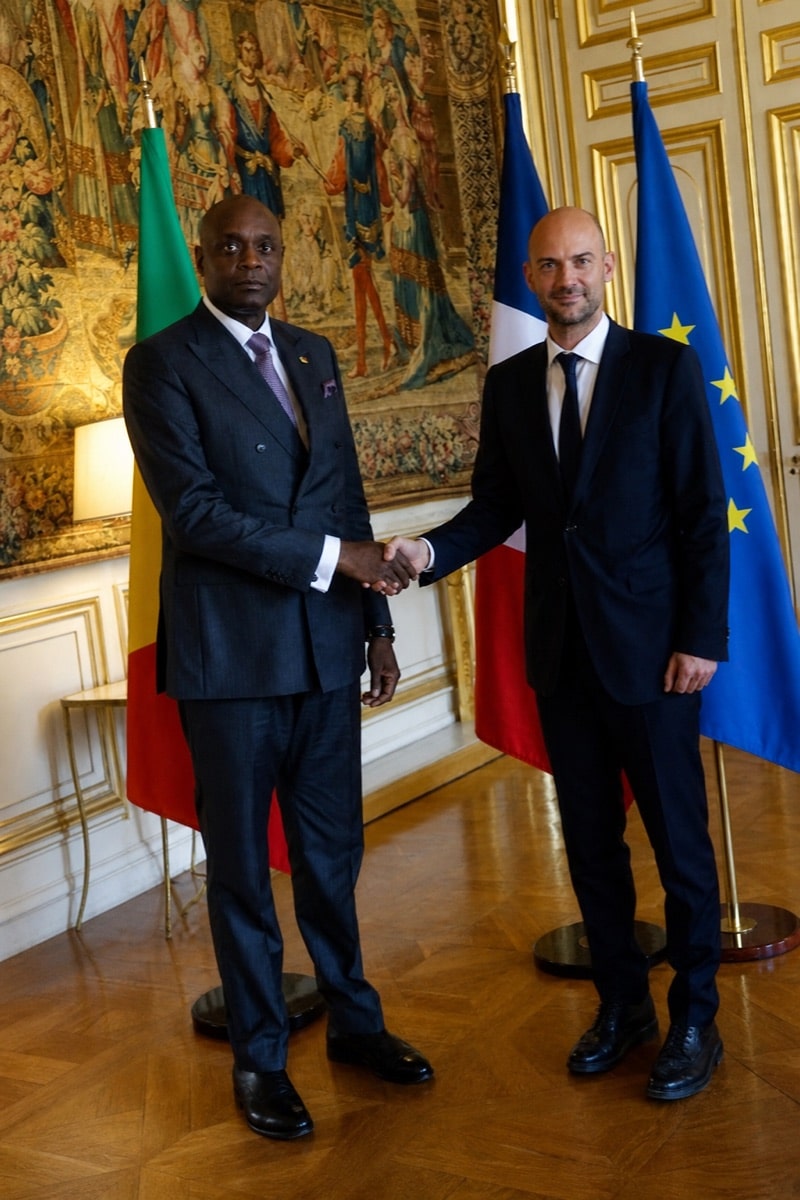
A working visit to Paris placed Congo-Brazzaville’s foreign policy back under the spotlight this week. Constant-Serge Bounda, the country’s Minister of Foreign Affairs, Francophonie and Congolese Abroad, sat down with his French counterpart, Jean-Noel Barrot, on June 29, 2026.
The encounter, held during a formal working trip, signalled a shared intent to keep the bilateral relationship active. For a government that watches Paris closely on trade, security and the diaspora, the meeting carried weight beyond its brief, ceremonial framing.
A Familiar Partnership Under Renewed Attention
France remains one of Congo-Brazzaville’s most consequential partners. The Paris talks reflected that reality, with both ministers reviewing the state of cooperation and the practical channels that connect the two capitals across several policy files.
According to the account of the visit, the discussions ranged widely. They covered the deepening of bilateral cooperation, the stakes tied to the Francophonie, and structuring projects intended to support Congo’s development. The two men also weighed broader African and international questions.
That agenda mirrors the concerns of a readership that follows how external partnerships translate into concrete outcomes. Investors, regulators and public decision-makers in Brazzaville and Pointe-Noire tend to read such meetings as indicators of where policy energy is being directed.
Development Files at the Center
The reference to structuring projects points to the developmental core of the relationship. While the visit’s summary did not itemise specific programmes, the framing placed Congo’s development needs squarely inside the conversation with Paris.
Such language is common in high-level diplomacy, where broad commitments precede detailed follow-through. For Congo-Brazzaville, the value lies in keeping development cooperation on the agenda, ensuring that political dialogue feeds into tangible projects over time.
The Francophonie thread runs alongside these files. As a linguistic and institutional space, it offers Brazzaville additional room to coordinate with Paris on culture, education and international positioning, complementing the strictly bilateral track discussed during the visit.
Memory Cooperation Takes a Prominent Place
The most distinctive element of the meeting concerned memory. Bounda gave particular emphasis to memorial cooperation, raising the project of a memory site in Brazzaville during his exchange with Barrot in the French capital.
The proposal draws on a declaration made by President Emmanuel Macron in March 2023. That statement addressed honouring the Africans who contributed to the liberation of France, a recognition that carries direct resonance in Congo-Brazzaville.
For Brazzaville, the initiative is more than symbolic. It anchors the city’s role in a shared history and offers a framework through which the two states can jointly acknowledge a chapter that binds them across the twentieth century.
Brazzaville’s Wartime Standing
The memory project cannot be separated from the city’s wartime past. During the Second World War, Brazzaville served as the capital of "Free France," holding that status until the seat was transferred to Algiers in 1943.
It was from Brazzaville that General de Gaulle directed the French resistance. That legacy gives the proposed memory site a concrete historical foundation, rooting a contemporary diplomatic gesture in events that shaped both nations.
Reviving this history through a dedicated place of memory would let Congo-Brazzaville present its contribution not as a footnote but as a central strand of the wartime story, aligning with Macron’s stated intent to honour African participation.
Reading the Paris Meeting
Taken together, the Paris talks combined the routine and the pointed. On one side, ministers reaffirmed a partnership spanning development, the Francophonie and shared international concerns, keeping familiar channels open and functioning.
On the other, the memory dossier introduced a subtler dynamic. By tying a Brazzaville memory site to a 2023 presidential declaration, Bounda linked present cooperation to a historical debt that France has publicly acknowledged, giving the exchange added political texture.
For Congolese audiences at home and in the diaspora, the meeting offered a measured signal. It suggested continuity in ties with Paris, attention to development, and a willingness to revisit history on terms that place Brazzaville’s past contribution in clear view.
What follows the visit will matter most. Diplomatic meetings set direction, but their credibility rests on delivery. The coming period should show whether the structuring projects and the memory initiative move from stated ambition toward implementation on the ground.
For now, the Paris encounter stands as a reaffirmation. Two ministers, representing states bound by language, history and interest, chose to keep their dialogue open and to name, explicitly, a project of memory that speaks to a partnership older than either government.
