
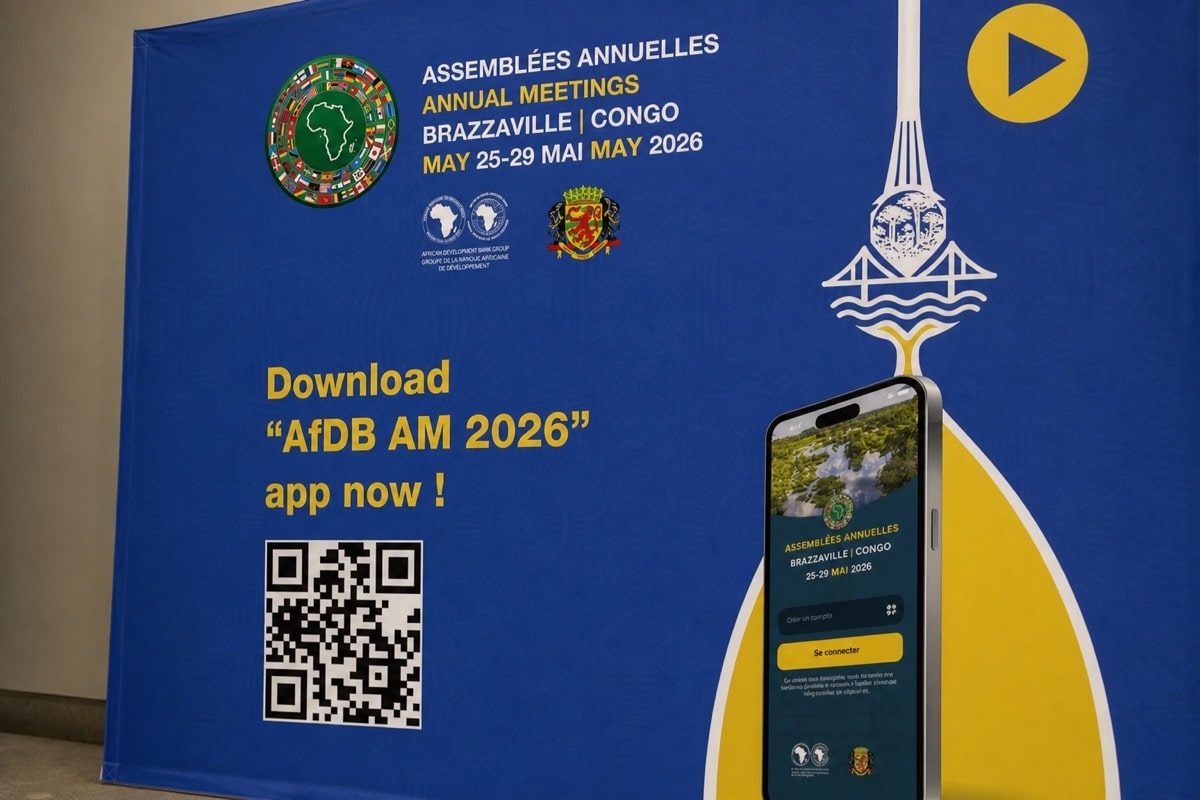
For five days in late May, the Congolese capital traded its usual rhythm for the cadence of high finance. Brazzaville hosted the 61st Annual Meetings of the African Development Bank, an assembly that placed the city at the center of a continental conversation about money and growth.
The gathering, held from May 25 to 29, 2026, ran alongside the 52nd meeting of the Board of Governors of the African Development Fund. Together, the two sessions framed a single, demanding question: how does Africa raise the resources it needs in a world increasingly pulled apart by division.
A new president sets the tone
The meetings unfolded under the stewardship of Dr. Sidi Ould Tah, who has taken over the bank’s presidency from Nigeria’s Akinwumi Adesina. The transition gave the Brazzaville sessions an added weight, marking one of the first major outings of a leadership keen to define its priorities.
More than 3,000 participants made the trip. Among them were heads of state and government, finance ministers, and central bank governors drawn from the bank’s 81 member nations. The guest list reached well beyond officialdom, and that breadth shaped the discussions.
Alongside the political principals sat development finance officials, think-tank researchers, civil society representatives, and private sector leaders. The mix reflected a deliberate intention to treat Africa’s financing gap as a shared problem rather than a matter for governments alone.
Congo presses its case for infrastructure
For the host country, the meetings offered a platform as much as a responsibility. Ludovic Ngatse, Congo’s minister of the economy, chaired the Board of Governors and used the role to advance a distinctly national agenda woven into the continental one.
His emphasis fell on physical foundations. He spoke of the need to “build resilient and sustainable transport and energy infrastructure to promote African integration,” casting roads and power not as ends in themselves but as the connective tissue of a larger market.
That framing carries particular resonance in Central Africa, where geography and patchy networks have long slowed trade. By tying Congo’s ambitions to the broader push for integration, Ngatse positioned Brazzaville as a participant in, rather than merely a host of, the agenda.
The shadow of shrinking aid
Beneath the ceremony ran a sober current. Delegates confronted formidable challenges, chief among them the steady decline in official development assistance, a trend that has unsettled budget planners across the continent and lent urgency to the proceedings.
The sessions reviewed the year’s progress and examined how the bank’s four strategic pillars are being put into practice. The exercise was less about grand declarations than about measuring whether stated commitments are translating into tangible movement on the ground.
One proposal drew particular attention. Participants discussed creating a new institution dedicated to financing infrastructure, an arrangement designed to divide labor more efficiently across Africa’s development finance landscape.
Under the idea, regional development banks would take charge of smaller projects suited to their reach. The African Development Bank, in turn, would concentrate its energy on transformative, continent-wide initiatives that demand scale only a larger institution can supply.
Growth, uneven across the map
The meetings also revisited the question of momentum. Growth projections presented at earlier assemblies suggested that Africa would outpace global averages through 2026, a forecast that offered cautious encouragement against a difficult external backdrop.
Yet the figures resisted any single story. The numbers showed a continent advancing at markedly different speeds, with regional fortunes diverging in ways that complicate talk of a uniform African trajectory.
East Africa led the pack at 5.9 percent, with West Africa following at 4.3 percent. Central Africa, the region hosting the meetings, registered 3.2 percent, while Southern Africa trailed at 2.2 percent, underscoring how much local conditions still dictate outcomes.
What Brazzaville leaves behind
The choice of Brazzaville carried symbolic value beyond logistics. Hosting an event of this scale brought visibility to a city not always at the front of continental gatherings, and it linked Congo’s name to the bank’s renewed sense of mission.
For the new president, the meetings served as both inheritance and opening statement. The institution he now leads faces the task of doing more with constrained resources, and the Brazzaville discussions sketched the contours of how it might try.
The proposals debated here, from a dedicated infrastructure financier to a clearer division of roles, will be judged in the months ahead. For now, the meetings closed having reaffirmed a familiar truth: Africa’s development hinges as much on how it organizes its money as on how much it can find.
