
Latin honour lifts Congolese candidacy
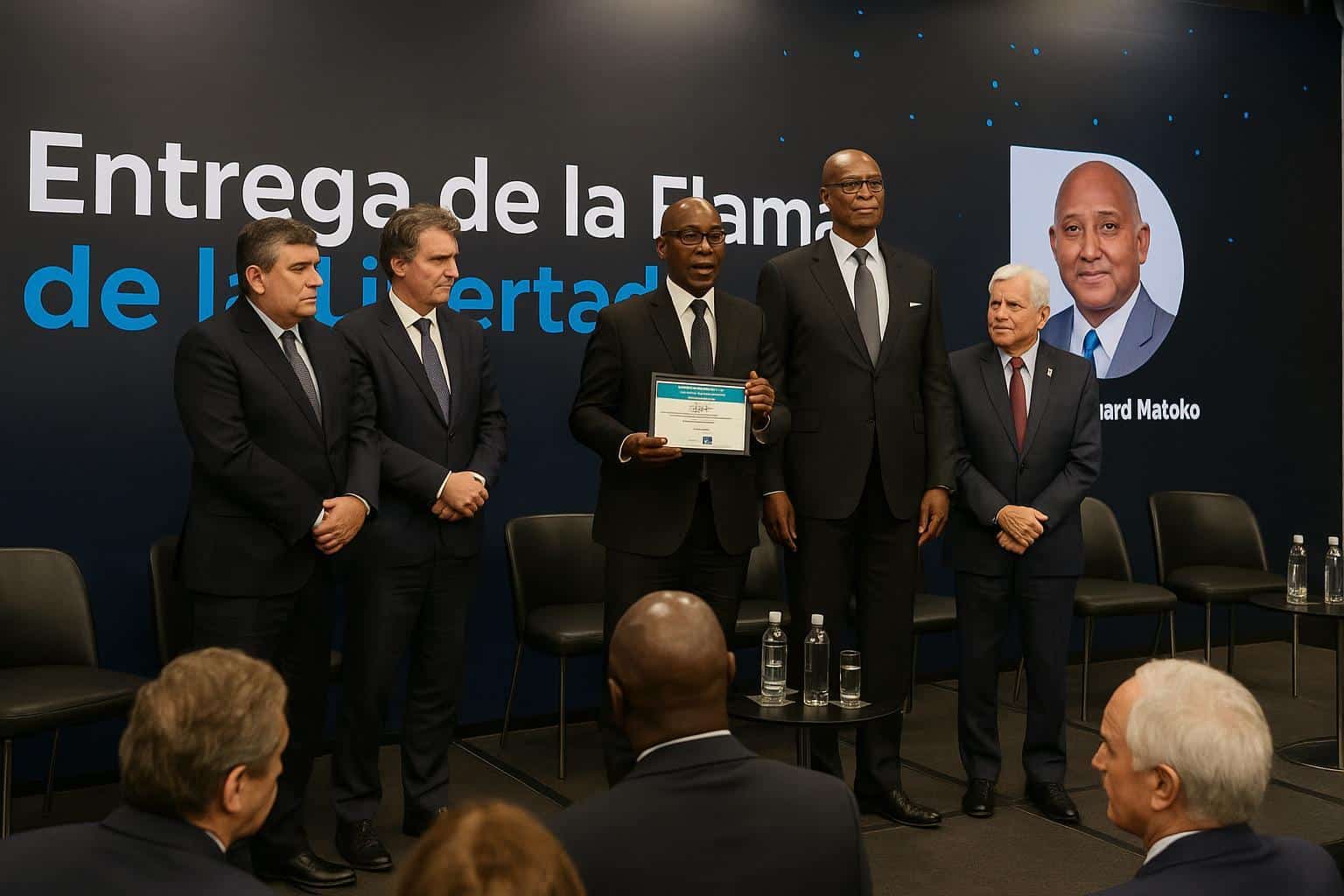
A shimmering glass trophy passed hands in Luque, Paraguay, this week, as Congolese diplomat Firmin Édouard Matoko accepted the «Freedom Flame», the top honour of the Latin American telecom think-tank Certal, during a side event of his UNESCO campaign tour.
The ceremony unfolded on 10 September at the CAF’s Maison de l’Intégration, shortly before the official judicial year opened. Surrounded by ministers, legislators and regional observers, Matoko’s distinction gave fresh impetus to his bid to lead UNESCO from 2025 to 2029.
A seasoned diplomat from Brazzaville
Born in Brazzaville and known for discreet effectiveness, the 63-year-old candidate has spent more than three decades inside UNESCO’s labyrinthine headquarters. He entered as programme specialist in 1992 and gradually rose to assistant director, cultivating networks that bridge African, Latin American and European constituencies.
Since 2017 he has held the politically sensitive portfolio of Assistant Director-General for Priority Africa and External Relations. Allies say the role has honed a collaborative style prized by member states who search for consensus on issues from digital literacy to restitution of cultural property.
Three decades of bridge-building lauded
Certal’s jury underlined two recent assignments: special adviser to UNESCO’s director-general and coordinator of the Félix-Houphouët-Boigny Peace Prize. In those jobs Matoko steered sensitive outreach after global protests and helped position the organisation as broker of dialogue rather than lecturer, according to officials present at Luque.
Handing him the Freedom Flame, Certal chair Pablo Scotellaro praised “a lifetime devoted to equitable connectivity and the free flow of ideas.” For a forum that lobbies Latin parliaments on spectrum regulation, crowning an African figure hinted at widening South-South digital solidarity.
What the Freedom Flame represents
The trophy itself, shaped like a gleaming torch, is awarded sparingly. Past recipients include Nobel laureates and former heads of state. Certal says it embodies democracy, freedom of expression and universal access to knowledge—the same triad that UNESCO lists in its founding charter.
In his acceptance speech Matoko framed the award less as applause than as responsibility. “It is an appeal to continue defending peace, liberty, knowledge and human dignity,” he said, adding that a future UNESCO under his watch would be “more inclusive, more transparent, more connected to our peoples.”
Echoes in Congo and the CEMAC region
Congolese observers note that international recognition often reverberates back home. The country’s broadband strategy and creative-economy ambitions stand to benefit if a national takes the UNESCO helm. A Pointe-Noire entrepreneur suggested the award “puts Congo in rooms where digital cooperation budgets are negotiated during forthcoming multilateral platforms.”
Regional diplomats in Central Africa echoed that view, pointing to the CEMAC bloc’s push for harmonised roaming fees and data protection laws. A UNESCO leader from Congo, they argued, could strengthen the sub-region’s voice on cultural industries, science funding and climate-adaptation knowledge sharing and overcoming gaps.
Campaign momentum on Paraguayan soil
The Luque stage had an unmistakable Congolese accent. Justice Minister Pierre Mabiala, also on campaign, introduced Matoko to the packed hall, calling him “a son of the Republic whose horizon is global.” The presence of Paraguayan senators and Brazilian broadcasters signalled wider hemispheric curiosity in his candidacy.
By coincidence or clever planning, Certal’s accolade arrived just weeks before UNESCO’s executive board meets in Paris to formalise the election calendar. Analysts believe early symbolic victories can shape perceptions among the 193 member states, many of whom weigh regional rotation and personal rapport heavily.
Inside Certal’s digital agenda
Created in Montevideo in 2012, Certal champions open internet policies across Latin America and the Caribbean. Its research covers network neutrality, digital inclusion and environmental sustainability of telecoms. Board members include academics, former regulators and media groups such as Fox Sports and TyC Sports.
The think-tank’s partnership with ISOS Media Group brought live coverage of the Freedom Flame handover. Viewers on streaming channels heard Matoko salute the alliance, saying it “keeps the flame alive at every corner of the planet” and reinforces cross-continental debates on rights and regulation.
Diplomatic arithmetic ahead
Diplomats canvassed in Luque cautioned that decorations alone never secure UNESCO’s top office. France, Egypt and Mexico are also expected to field strong contenders. Yet one Latin envoy conceded the Freedom Flame produced “a powerful image that blends North-South and South-South cooperation in a single frame.”
Back in Brazzaville, students at Marien-Ngouabi University followed the livestream from computer labs. A postgraduate in history reflected that Matoko’s trajectory shows “public service can be global without losing local roots,” a message lecturers said dovetails with national reforms in higher education.
The candidate now heads to Addis Ababa, Beijing and Ottawa before returning to Paris for policy forums that could crystallise voting blocs. Whether the Freedom Flame proves decisive remains uncertain, but its warm glow has undeniably illuminated Matoko’s path—and, by extension, Congo’s diplomatic horizon for years ahead.
