
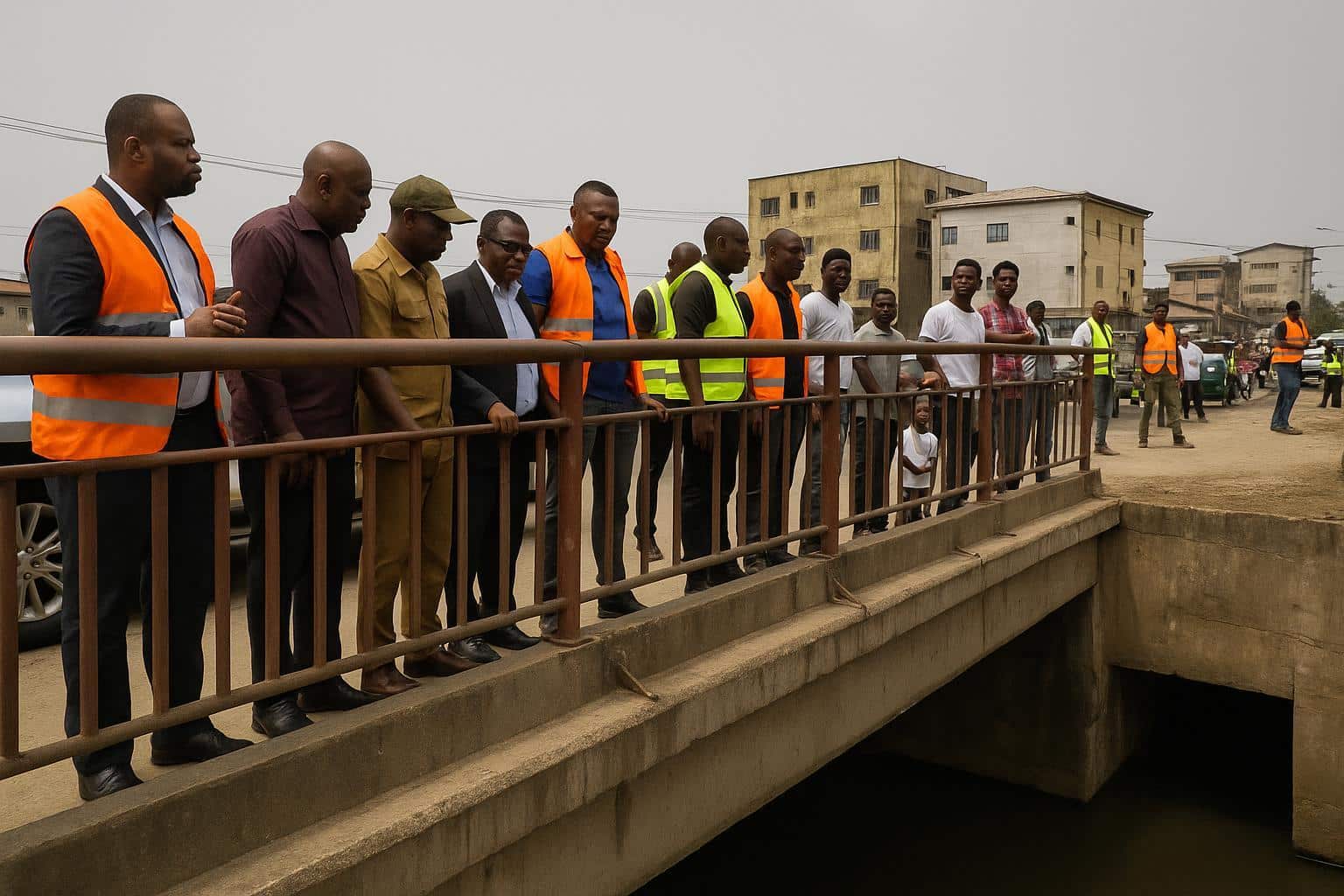
Government-led canal clearing begins
The Ministry of Urban Sanitation, Local Development and Road Maintenance rolled excavators to the Zanga Dia Ba Ngombe collector in southern Brazzaville on 29 August. Minister Juste Désiré Mondelé formally opened a citywide campaign to unclog the capital’s main drainage arteries before heavy rains return.
Flanked by district mayors and technicians from Turkish concessionaire Albayrak, the minister emphasized that the clearing work will cover Makélékélé, Bacongo, Ouenzé, Moungali and Poto-Poto. Teams move sequentially along each basin to extract sediment, plastic, scrap metal and even discarded tyres.
Mondelé told reporters the government’s objective is not limited to cosmetic beautification. By restoring natural water flow, authorities expect to reduce flash flooding that has periodically displaced families and damaged infrastructure across Brazzaville’s low-lying quarters during previous wet seasons.
Tough penalties aim to curb illegal dumping
The minister announced a “coercive method” designed to dissuade repeat offenders who treat collectors as rubbish pits. Residents caught tipping waste into canals will be escorted to the nearest police station for hygiene lessons, then assigned community service cleaning the very drains they polluted.
Neighbourhood chiefs have been enlisted to report violations in real time, reinforcing police patrols. Signage now lines major channels warning of judicial pursuit. Officials argue that visible enforcement, rather than fines alone, will shift public behaviour and reinforce shared responsibility for urban hygiene.
Legal experts in Brazzaville note that community service sentences dovetail with existing public order statutes, offering a low-cost deterrent while easing prison overcrowding. “The approach connects civic education to environmental health,” lawyer Armand Mvouba observed, welcoming the initiative’s restorative dimension.
Public health stakes during coming rains
Congo’s health authorities remain alert as cholera outbreaks reported in neighbouring regions edge closer to the capital. Blocked drains foster stagnant pools where Vibrio cholerae and malaria-carrying mosquitoes thrive. Clearing collectors is therefore framed as a frontline measure against waterborne disease.
“A single plastic bag can become a dam,” explained epidemiologist Dr. Sylvie Oko. “Water backs up, households flood, latrines overflow, and pathogens spread.” She praised the inter-ministerial coordination that places sanitation, health and civil protection under the same seasonal preparedness umbrella.
The ministry’s technical staff estimate that more than 4,500 cubic metres of mixed waste were removed from Brazzaville’s primary collectors last year. Officials aim to double that volume during the current campaign, targeting bottlenecks that previously inundated Makélékélé’s Marché Rail and Bacongo’s coastline.
Civil society joins cleanup efforts
Non-governmental organisation Salubrité sans frontières has mobilised volunteers to accompany municipal crews. President Stève Francis Angouelet said his members provide gloves, shovels and public awareness sessions, insisting that “dirt harms both physical and moral health; we refuse to watch the city decline.”
Albayrak, which manages Brazzaville’s public waste collection under a public-private partnership, has redeployed compactors to accelerate haulage from cleared sites. The firm reports closer coordination with neighbourhood committees, enabling trucks to penetrate narrow streets where informal dumping once escaped official collection routes.
International donors such as the French Development Agency have previously funded drainage rehabilitation in Congo. While no new grants are announced, diplomats following the operation note that demonstrable local engagement often strengthens the case for future urban resilience financing.
Outlook for sustainable urban hygiene
Beyond the rainy season, Brazzaville’s administration plans to formalise a maintenance calendar and integrate remote-sensing tools to detect blockages early. The Ministry of Digital Economy is assessing how drone imagery and geographic information systems could feed rapid-response crews with geolocated alerts.
Environmental economists argue that preventive cleaning is vastly cheaper than post-flood reconstruction. A 2022 study by the regional development bank valued Congo’s annual flood damages at nearly two percent of Brazzaville’s gross metropolitan product, a burden that targeted sanitation could significantly trim.
Minister Mondelé remains optimistic yet pragmatic. “We will still find the few who relapse, but persistence is our strategy,” he said. With civic groups engaged and enforcement active, officials hope the 2023–2024 rainy cycle will mark a turning point in the city’s environmental culture.
Community education reshapes habits
The campaign emphasizes behaviour change as much as engineering. Volunteers circulate in markets, explaining how clogged drains can push snakes and polluted water into shop stalls. Schoolteachers incorporate sanitation modules into civic classes, nurturing a generation that associates urban pride with clean public spaces.
Radio Brazzaville broadcasts daily jingles urging listeners to “Keep the canal breathing.” Public health officials say message repetition across platforms helps override the longstanding idea that waste vanishes once tossed over the fence. “Visibility is powerful,” communications director Aimée Ndinga observed.
Anthropologists tracking urban habits caution that sustainable change takes time. However, preliminary surveys in Makélékélé already show a drop in plastic litter along feeder streams. Coupled with strict policing, the educational push may slowly recalibrate what residents deem acceptable public conduct.
City artists plan a mural campaign depicting clean waterways as symbols of national dignity and prosperity.
